Sunday, February 8, 2015

San Francisco and Baja California


San Fran and Baja California January 2015

Had an enjoyable 3-day visit with Jill and family. Stayed at a VRBO about 3/4 mile from their home - comfy living area and bedroom, small kitchenette area on the bottom floor of a charming home on an acre or so at the top of West Seaview Drive - giving us a challenging hike home on the two days we walked the neighborhood for morning exercise.

Jan 20- uneventful flights, on time. Movies- The Good Lie, and This is When I Leave You. We rode the Marin Airporter to San Rafael and Graham met us, took us to the grocery store, and then to their house for dinner with the children, Rosa Laura the Italian au pair and Graham and Jill (a little later).

Jan 21- Graham gave us a ride to the ferry terminal and we rode over to San Fran for an 8 mile round trip walk to Fort Mason for some WWII research with a stop on the way back at Ghirardelli Square. Then Jill and Graham's for dinner.


Jan 22 - today we took a walk around downtown San Rafael and then went to pick up both children, Ravenna at gymnastics and Theron at preschool. We met Jill and Graham at Terrapin Crossing for a burger dinner.

Jan 23 - another walk around the suburbs of San Rafael along the San Pedro road and then some back streets. We had a great lunch with friends from the Trans Siberia Rail trip, Bob and Diane Coleman, who live in Piedmont near Oakland. Bob is the friend who got Beth the photo shoot for American Fondouk (veterinary hospital in Morocco). The lunch was at Fort Baker near the Golden Gate Bridge. After lunch we met Ravenna and Theron and Rosa Laura at music class at the Exploratorium. We had a pizza dinner, washed some clothes and packed for the next part of the trip.

Jan 24 - we flew to LAX and then to La Paz in Baja, boarded a bus and rode for 3 1/2 hours to San Carlos to get on the Sea Bird. It was a very long and somewhat uncomfortable ride but it's over. The trip ends back in La Paz so we don't have another long bus ride to face. The Sea Bird can accommodate 62 guests, most in outside facing rooms.  Ours is 217, about 12' x 12' including combo toilet/shower area. We have 2 windows, 4x3 and 2x3 so can sit on the bed with a clear view of the vista as well as all those who pass by our room - and they of us. 


Jan 25 - the ship traveled north overnight from San Carlos to Bahia Magdelena and to Bahia Santa Maria where we stopped at Sand Dollar Beach, a place with huge wild dunes and a long stretch of Pacific Ocean beach without a building or another soul on it. Bahia Magdelena is the inside and Bahia Santa Maria is the name of the ocean side. On the Pacific side there is long flat beach with huge nicely curling rollers about 100 yards out. On the bay side (inside) (this bay is about as big as San Fran Bay) the dunes come right down to the water. Then we came back to the boat and entered the Hull Canal which is very narrow, mangrove lined, and a good place for spotting birds. The only new species was brant (a kind of goose) but there were plenty of brown pelicans, double crested cormorants, great blue herons, great and snowy egrets, an osprey, magnificent frigate birds (kleptoparasites) and gulls, either California or western. As the channel widened we entered whale territory and were surrounded by gray whales and calves. Baja is where they come each year to mate and to have their calves (with a midwife whale) every year before beginning the trek north to Alaska. We also had porpoises bow riding the ship and swimming in and out of the whales.
More about gray whales later.
My new Zeiss birding binoculars which Connie gave me for Christmas were perfect for spotting the birds and the whales. Muchas Gracias!


Jan 26 - Boca de Soledad-  today we went ashore at another beach (on Isla Magdelena) where the dunes were even larger and the ocean stretch just as deserted. Connie and I jumped off a big dune and I will probably still be getting sand out of my ears for a couple of weeks when we get back.


For the second part of the morning we went out in the zodiacs with local Mexican guides to see the whales up even closer.
This was not the polar bear experience as we had at Svalbard where they were at long distance. Here the zodiacs went up to within 30 or 40 feet of the moms and babes. We watched "logging" moms where they just lie quietly at the surface, perhaps while the calf nurses. We also found one very cooperative mother who seemed to enjoy coming up right under the zodiac and nudging it with her head. She also allowed us to touch her. So far the babes have not been as cooperative, but the guide tells us these calves are very young and so they are mostly feeding and practicing their swimming skills for the trek north.


Added a white ibis and a whimbrel or curlew but the whales were the stars of the show today.
The afternoon was a repeat of the morning- half of the passengers at the beach and half whale watching and then a late afternoon switch. We stayed in for the beach portion to catch up on this journal.
The afternoon whale watching was just as good as the morning- again I got to touch a mom who came up right under the boat. One special added feature was delighting in a panga full of Mexican school children watching the whales and having the whale come under their boat and move it around.


About the Baja California Gray Whale- the current count is about 24000 and stable. All are born right here where we are, all about this time of year. These are baleen whales and bottom feeders. They communicate via a low hertz vibration which is good for communicating over long distances but not as an alternative to sight. They really don't need to see very well. In Baja waters they are in about 25 feet of depth, and for a 45 foot whale there is no need for deep diving. Hold breath for 5 minutes. Babies weigh 800 pounds when born and are about 15 feet long. The gestation period is 11-13 months, and they are sexually mature at about  12 years old. Male testes weigh about 80 pounds and the theory is that when mating they want to have huge volume of sperm to push the other guys' sperm out. There is no fidelity- multi mates on both sides. The biggest predator is killer whale or orca and the orcas won't come into the close confines of the Baja bays so that's why this is the birthing spot. Gray whales have no dorsal fin, just a bump and then a few knuckles down the spine. All adults have barnacles and amphipods on their back. The amphipods as well as some fish eat dead skin. The babies acquire barnacles and lice (the amphipods) by nursing and rubbing against the mom.


The moms keep close tabs on the newborn and don't let them interact or play with the other calves for a while. They basically have the babes swimming against the tide up and down in the bay here to get in shape for the long swim north to come. Tired of whale photos yet? I only have about 250 more.


We had them 360 degrees around us at several times. The babes we saw never got more than 15 or 20 feet from their mom.
One other side note- the Nat Geo photographer on this trip is Flip Nicklin, who is somewhat famous for his photos of whales and narwhals. He told me he pitched his first story on whales to Nat Geo in 1980. At the time Nat Geo had done 3 whale stories before and said that was enough. By the way two of those three had been done by his father. Anyway, he persevered and now has done 22 more whale stories for Nat Geo. Re the  narwhals he told me he spent 4 1/2 months trying to get photos and the only good ones he got occurred within one 7 hour period of one day.

Jan 27- Repositioning day. We are now leaving the Bahia Magdelena area and Boca de Soledad, heading back thru the Hull Canal on to La Entrada, the entrance to the bay at sunset. Tomorrow we run down to Cabo San Lucas.
This morning we went for one last gray whale expedition and stayed with one mom and calf pretty much all of the time we were out. This mom was known to the local guide as a splasher. True to form, while she came close many times and let us touch the calf, when she was tired of us she gave us a pretty good drenching with her tail.


As we were going down the canal, I saw a very large, very chubby coyote on the sand flats just walking along.
Lunch today was a barbecue on the deck. Very nice.
One of the reasons we like these Lindblad Nat Geo trips is the way the tour organization works with the communities it visits. Here we have a local pilot although the boat has all the navigation equipment in the world. Also instead of taking business away from local whale guides, who are fishermen in the non whaling season, Lindblad hires them to guide the zodiacs. Last night we had some local fishermen on board to play Mexican music during dinner.

Jan 28- last night was a night at sea with moderate chop and wind maybe 20 mph.
This morning we came to the Friars marking Cabo San Lucas at about sunrise. We went right by the town of Cabo, which is a little bit of Southern California right here in Mexico. The ship went on to San Jose del Cabo. This whole area was hit hard by two hurricanes this fall and did not have power for a month. Our guide said it was like being thrown back to the Stone Age. However everyone pitched in doing everything and helped to get it back up and running. He cut a lot of trees with a machete because there was no gas for a chain saw. We saw a lot of storm damage- the big hotel hasn't reopened and the windows are still out. Lots of piles of debris and trees down still. 


Our activity here was a birding walk along a stream which comes down from the local mountains, running mostly underground. I saw about 20 species of birds which I'll list later.
At the time I write this we just finished lunch and are slowly cruising the Gorda Banks by Point Gorda looking for humpback whales. Because we will only see them at a distance I am now spoiled and really only interested in touching them. The wind is up and we have to cruise all night so things may get a little bouncy.
I need to change my opinion on looking out for whales. This afternoon we saw probably 15 or 20 humpbacks from long distance. We saw perhaps 10 or so bodies and tails rather than just spouting. However at the very end we got very close (50 yards) to a threesome which was showing tails, bodies, spouts and probably 10 or 12 full and partial breaches. It was quite a display.

Jan 29- it was the second night at sea and both were quite rough. Luckily for all the expedition leader decided to cut the trip north short at about 2 am and pulled into the bay at Punta Dispensa on Espritu Sanctu Island. We finally got some good sleep starting about 4.
In the morning Connie and I went ashore for a long walk on the beach and then on the desert and then up a hillock on the island. There was a lot of ocean debris- rocks, shells of many types, fish skeletons, and hollowed out pieces of dead cactus. Connie saw a black tailed jack rabbit. We also saw some American oystercatchers. 


Back on the ship at lunch we had a Mexican lunch of make it yourself stew (posole). Then we had a choppy but brief ride to Isla San Francisco. This was one of the most interesting excursions of the trip so far- we went wading in a tidal pool just like John Steinbeck and Doc in the Log from the Sea of Cortez which I am about half way thru now. We saw urchins, brittle stars of at least two kinds, some relatives of blood worms, hermit crabs and other unnamed, unclassified, by me anyway, animals. It was a perfect activity for a 12 year old boy. After that we went for a brief kayak ride and then had a barbecue on the beach.


Jan 30- Los Islotes and Espiritu Santo. This morning the first activity was a zodiac ride around these small islets that have roosting areas for blue footed boobies and sea lions. The coyotes on the larger islands can't get them here. An added bonus was a display of jumping and flopping back into the water by mobula rays (they look like little manta rays).


Connie snorkeled with the sea lions. Then we made a small move to another part of the island and closed out the trip with a long hike on a beach bounded by a cactus desert inside. The evening lecture was about John Steinbeck and Ed Ricketts, the real life role model for Doc in Cannery Row.
In reviewing the Lindblad daily expedition report I found out the next trip does not repeat what we did. Instead it moves further north on the Sea of Cortez side and immediately they were seeing blue whales.
As for us we went to LA on Jan 31after a brief side trip to a very interesting serpentarium.


We  landed in time to watch the Duke UVA game and then go to dinner at Akasha in Culver City with Richie and Darla. It reminded me a lot of Matt's restaurant Southbound here. 
The quote of the trip was "it never rains in Baja California" but it did while we were there- not bad but it did happen about 3 times.
The next day we got home just in time for the Super Bowl. Ugh, poor Russell.
 A salute to Nat Geo Lindblad's great staff of naturalists and photographers-


Bird list-
Pacific side- magnificent frigate; sanderling; brown pelican; double crested cormorant; great blue heron; great and snowy egret; brant; osprey; white ibis; whimbrel.
Sea of Cortez side- Cassin's finch; white wing dove; Cassin's kingbird; common snipe; American coot; white faced ibis; tricolor heron; little blue heron; long billed dowitcher;  black neck stilt; yellow rump warbler; hooded oriole; pie bill grebe; gila woodpecker; ruddy duck; spotted sandpiper; red bill merganser; blue wing teal; belted kingfisher; red billed tropicbird.
Punta Dispensa and Isla San Francisco- eared grebe; yellow foot gull; brown booby.
Los Islotes- blue footed booby.

Wednesday, September 24, 2014

On the trail of the Atlantic Sturgeon

A short addition to the Fishing Journal- 9/20/2014

My Dad got me interested in work being done at VCU by Matt Balazik on Atlantic Sturgeon. I contacted Matt, helped him out a little, and basically pestered him to take me out one time when he is netting and tagging the sturgeon.
This day was a beautiful late summer day, clear, 70s- low 80s, with a nice 10 mph breeze. We left from VCU's Rice Center in King Charles County Va on the James and proceeded upstream just past Hopewell and right at the entrance to the Presqu'ile cutoff. That's where Matt set his nets. His cute wife came along to help him with the boat driving and the record keeping.
Late September is getting to the end of the season and the males are waiting around in low salt water for ovulating females. This year we haven't had any rain so the fish have pushed far up river and even been seen where I shad fish at 14th Street in Richmond.
Before setting the net Matt put his hydrophone in the water to listen to fish which had been tagged earlier. We could hear lots, some more clearly than others. When the numbers would show on the screen, I was amazed that Matt knew the numbers and tag history by heart. We did not find any of my tagged and named fish from the last couple of years.
We caught and tagged 3 in a short day and worked in a little outreach with folks who were visiting the nature preserve.


These males were about 5 feet 6-10 inches long. With these 3 Matt has tagged about 470 fish in all and about 75 or so this year. An excellent day.


Tuesday, September 23, 2014

The Canadian Maritime Provinces (or Atlantic Provinces) with Lindblad/ Nat Geo on the Explorer


Canadian Maritimes with Lindblad NatGeo 9/8/2014- 9/18/2014

9/8 Ric to Newark to St. John's Newfoundland- uneventful flights, all on time.

After being squeezed between the babies (8 surrounding seats and 2 babies, 1 toddler and 1 regular kid) on the August trip to Reno, I thought we might catch a break on this trip. No such luck- in addition to the plane's microphone being set super loud, and incessant messages from that source, the guys behind us, having never met, started a conversation that went on from Richmond to Newark. The joys of travel.
When we got to St. John's we went to the Sheraton which is right on the harbor for some sleep and then departure in the morning to Fogo Island, Newfoundland.
I knew and still know practically nothing about this part of the world, but I learned a few things from our drivers. St. John's has about 200,000 out of Newfoundland and Labrador's combined 500,000 people. The province was the last to join Canada, in 1949. The town has a lot of old money from cod fishing families but now relies mostly on 3 off shore oil rigs  about 350 km away. The royalties support a lot of what the province wants to do. Unemployment in St John's is about 13 %. A lot of the young people from here now go to Alberta to work in the energy business.
The average temp is 32 and our guide said that in winter it snows during the week and melts just in time for when people want to go skiing on the weekend. The usual weather is RDF- rain, drizzle, fog.
Gander is probably the most famous place in the province because it was the stopover for transoceanic flights in an earlier era and because many of the planes diverted from NY during 9/11/2001 came there. See the book- The Day the World Came to Town and the play Come from Away.
I think the Maritime Provinces are Newfoundland (which is officially Newfoundland and Labrador), Nova Scotia, Prince Edward Island. Cape Breton Island which we visit is part of Nova Scotia. If you add Quebec you have the Atlantic Provinces. For only 9 Provinces, 2 territories and one "first nations" area, Canada is pretty confusing.

9/9 Fogo Island Inn

The day started off with a fluster in that we were told we needed to trim our suitcase down because of the small plane to Fogo (much discussion about whether we had advance notice of this among the 8 of us, 6 guests and 2 Nat Geo staff, going to Fogo (we were known as the Fogo 8)). We did that in a big rush and so I ended up wearing the same clothes for a couple of days. (And by the way there was plenty of room on the plane for all our luggage but cutting it down made choices a lot easier.)
Then when we got to the airport the fixed base operator did not know about our flight. While all that was working itself out, we got to talk to a couple of oil platform workers who were coming in by helicopter from their 21 day, 12 hours on 12 hours off rotation. Needless to say the wives and children were waiting and very glad to see them. On the way up from Newark about half our plane was young men carrying only gym bags and I was wondering why a weight lifting team would be going to St. John's, but, aha, it was the next batch of oil platform workers coming up for their 21 days.
Our flight was on a prop jet and the pilot stayed low so we could see a lot of the coast. St John's is on a big island and Fogo is north and east of that across three big bays with names like Discovery, Trinity, and Bonavista. It sounds like Captain Cook was here. Also John Cabot landed two bays below Fogo in 1497. This map of the island is from the elevator wallpaper at the inn-


The Inn defies description and I would suggest the reader just go to the Fogo Island Inn website or see the 2 youtube links

http://youtu.be/3jwJ1ByjIQ0  Zita Cobb talking about Fogo Island and the Shorefast Foundation (hang in there- it starts off in German?) (20 minutes)

http://youtu.be/idGKrSfZZtE Photos of the Fogo Island Inn in all seasons ( much shorter).

  Our room sits over some of the support poles on the left here and has a wonderful very close up view of the  rocky shore and Atlantic. The room is on two levels with a living area and bathroom downstairs and the sleeping area upstairs. The inn has 29 rooms, all with a view and sound of the Atlantic Ocean (windows that actually open!!!) and 400 mm year old rocks. The weather right now is clear and the sea breeze is fresh.


Our day's activities included some orientation, 2 great meals (a hearty Lamburger lunch and halibut dinner for me), blueberry picking near the town of Tilting, past the town of Joe Batt's Arm (Joe was thrown off or left Cook's ship), and a side trip to our helper Norm's personal garden. 


We brought our berry harvest back to the Inn for "infusing" and then drinking tomorrow night. Lastly we had a lecture by the founder of the Inn, Zita Cobb, who, as a native who had business success (JDS Uniphase and Nortel), has come home to try to revive her community after the collapse of the cod fishery. (Fogo has about 2500 people now; one of the girls in the restaurant told us she graduated high school in a class of 14 here.) When the cod fishery died from over fishing in the 80s/90s, Canada paid many of the people dependent on it to resettle on the interior. The Fogo Islanders refused, with many now earning a living from crabbing, shrimping, and making crafts and working at the Inn. The Inn targets a 15% margin and gives all that to the Shorefast Foundation started by Zita and her brothers. The Foundation supports the Fogo communities with things like a micro finance program (very proud of the financing for a greenhouse which produced the first ever Fogo melon this year). Another example of what the Inn and Foundation do to help the community is that if you stay at the Inn but want to go to the local restaurant you tell them you are at the Inn and your meal is covered- sort of the "we're all in this together" concept.

9/10 Fogo Island Inn-

Each morning the Inn provides a "tackle box" outside the room which is coffee, tea, and a small treat to get you to breakfast. After that we went with our group of 8 on a small boat ride to Little Fogo. The captain (Aneas) and two of the other locals who meet us there (coming over by open outboard) have deep roots in the little community of people who used to live there.  Now it is mostly birds (with lots of stories about the changing bird species roosting there over time) and a few hardy souls rebuilding cabins for summer stays. We got lucky- another clear day with a marvelous fresh breeze. On the little island we had a "boil up" which is like a picnic lunch on the shore with boiled snow crabs. We did see some Atlantic Puffins but most have moved out to sea until next breeding season.


A side note- the locals, who are just a wonderful people with terrific senses of humor and great and very different accents, say their old relatives came here to get away from England and Ireland and from trouble with the law there. They came first to St John's and the bigger places but they could still be impressed into service or shipped to Australia for past sins if nabbed so they came up here where no Navy ships would come because of the ice and difficult navigation.
The locals say the water is about 40 degrees now and that a person could not survive swimming only 50 yards to shore. They also say the last iceberg each year floats thru in mid August. Other local tidbits include- great brook trout fishing in July but the black flies peak then too and will carry you away, and a small resident caribou herd.
Birds- cormorants, Atlantic puffins, herring gulls, great black backed gulls, glaucous gulls, and a curlew. No whales or eider ducks this time of year. The last great auk colony was just off Little Fogo, and Joe Batt's Arm has a Great Auk statue to commemorate it.
Tonight's dinner started with mint juleps using our infused blueberries from yesterday, put together by a very knowledgeable and enthusiastic bar tender. Nice to know we helped put food on the table. Salt cod for dinner.
The inn seemed about half to 2/3 full. We met a woman who was a 9/11 widow and came up here with a friend to avoid the attention the anniversary brings.


9/11- Fogo to meet up with the Explorer in St. Pierre, France via St. John's

All I can say is I am glad we signed up for this pre-extension of our trip. Looking down on the Atlantic and the rocky shore from our room and smelling the ocean air and burning wood at night has been invigorating.
While waiting to go to the airport for the charter flight back to St John's, I met Make and Break, the two Newfoundland dogs kept at the inn. Huge, Saint Bernard like, big slobberers, they would never make it with the heat in Virginia. Later I learned there are 3 characteristics that make the NF dog what it is- webbed feet, an under coat that is water repellant, and a thick tail to paddle with. We also learned that the Lab breed started off as a blend of the NF dog and English and Irish setters. This photo is from St. John's, but from when we were there later in this trip:


In St John's we had a lunch and then went back to the airport for a flight to St. Pierre, the last little bit of France in the New World. Lindblad had 4 flights lined up to get everyone to St. Pierre and they were running pretty late.
My suggestion for next trip, if there is a side trip to Fogo and if the start is in St Pierre, would be to have the return Fogo charter go straight to St. Pierre.
Once all were on board we left port for Louisbourg, which is Nova Scotia.
Our room was 218, on the port side and for the first time we had an outside sitting area with 2 chairs. We probably liked this room the best of any we have had on Lindblad. Next time though we might try for 219 or 230 which are at the corners on the stern.


9/12 Louisbourg and Baddeck, Alexander Graham Bell's summer home on the inner salt water lake at Cape Breton Island

Although we left France at St. Pierre we stayed in a French influenced area at Louisbourg, Nova Scotia on Cape Breton Island. Louisbourg swapped hands several times back in the 1700s when England and France were fighting over control of their part of the New World. France lost out by only anticipating invasion from the sea. Louisbourg now is a Parks Canada living history museum much like Williamsburg Va with reenactors who stay in character almost all the time. We got an interesting look into life in New France in 1744. The gardener and the house maid were the most instructive, but in the church, inside the fort itself, we also saw a statue of St. Roc showing off the leprosy on his bare thigh, which was kind of odd.


It was a tight day timing wise because the ship had to go to Baddeck while we went by bus. Baddeck is home to the Alexander Graham Bell summer home and museum. On this part of the trip Gil Grosvenor, AGB's great grandson and former Ethyl board member, was with us, and he gave a lot of background about Bell's accomplishments beyond the telephone. Among many, some of AGB's interests were in teaching the deaf, flight, hydrofoils, kites and tetrahedrons. Gil told us the family is now restoring the Bell home called Beinn Bhreagh (beautiful mountain in Gaelic) and the cost may bankrupt them.
Gil gave the group a couple of lectures including one about where the National Geographic Society (NGS) has been and where it is going. Founded by an all star cast of Bell, John Wesley Powell (Grand Canyon explorer), Horace Greeley (go west), the first Grosvenor (GHG) who was chasing Bell's daughter at the time and became editor of the magazine, NGS has also had an all star group of scientists it has supported over time, including Hiram Bingham (Machu Piccu), Jacques Cousteau, the Leakeys, and Jane Goodall. NGS is struggling to adapt to the digital age- subscriptions to the magazine are way, way down.
A little aside about Gil on this trip- he had to leave early because his wife was having a medical issue, but on the first day I was the second person to talk to him after his lecture. The first person to talk to him was his old college girl friend whom he hadn't seen in more than 30 years and whom he thought had died from a stroke. So when he was talking to me and then for the next couple of days he was very flustered by the surprise of meeting her on the ship. It pays to look at the passenger list ahead of time.
After Louisbourg and the museum we still had time for a short walk around Baddeck (pop. 750). Connie immediately went to the yarn shop. I met her there a  little later and ended up in conversation with the man who worked there as #2. Time for a second long lost love story- The man lived in Edmonton after retiring from a long career in the Canadian army. One day about 6 years ago he got an email from a "Mary" saying she liked the jokes he had been sending to some other guy. It took him a while to put it together but he figured out Mary was his high school sweetie that he had parted from on not such good terms. Now 40 + years later she emails him. She lived in Baddeck and was divorced. They agreed to meet in Toronto. After 4 days they both went their ways home but as soon as he got back he called her and said he would move to Baddeck if she would have him. She would, he moved, they got married, and he has learned to knit and helps her in the store!

9/13 Iles de la Madeleine

These skinny little islands, 90 miles in total length, are technically part of Quebec and sit  in the St. Lawrence Bay. At places it seemed they were no wider than my office building.
These islands have pretty much the same story as Fogo- dependence on the cod and then that vanished. Young folks are leaving and nature is slowly eroding the islands. If a big hurricane hit, like Cape Hatteras, these islands would be gone.
Our guide on the bus here was named Gilles and when he isn't guiding he is a musician in a band that sounds almost exactly like the Cajun music one hears in New Orleans. Gilles plays the "bones" which are two beef ribs while he sings. We heard his group play over lunch.
This is a good time to bring up Evangeline by Henry Wadsworth Longfellow and the Acadians. They came from the La Rochelle area of France and settled on the Gaspe Peninsula among other places. They were ok with swearing loyalty to the British when they were established as top dogs in the mid 1700s but said they preferred not to have to fight other Frenchmen if there was another war. That kept things steady for a while but eventually the Brits threw them out, and there were two migrations down the Atlantic seaboard and possibly via the Great Lakes. A large group ended up in the bayous of Louisiana becoming what we now call Cajuns. Evangeline tells this story in what we would now call very stilted language- Evangeline is about to marry Gabriel when he is forced to leave. After a while she goes looking for him. She gets a trace of him in Louisiana but only finds him on his death bed years and years later in the American Southwest.
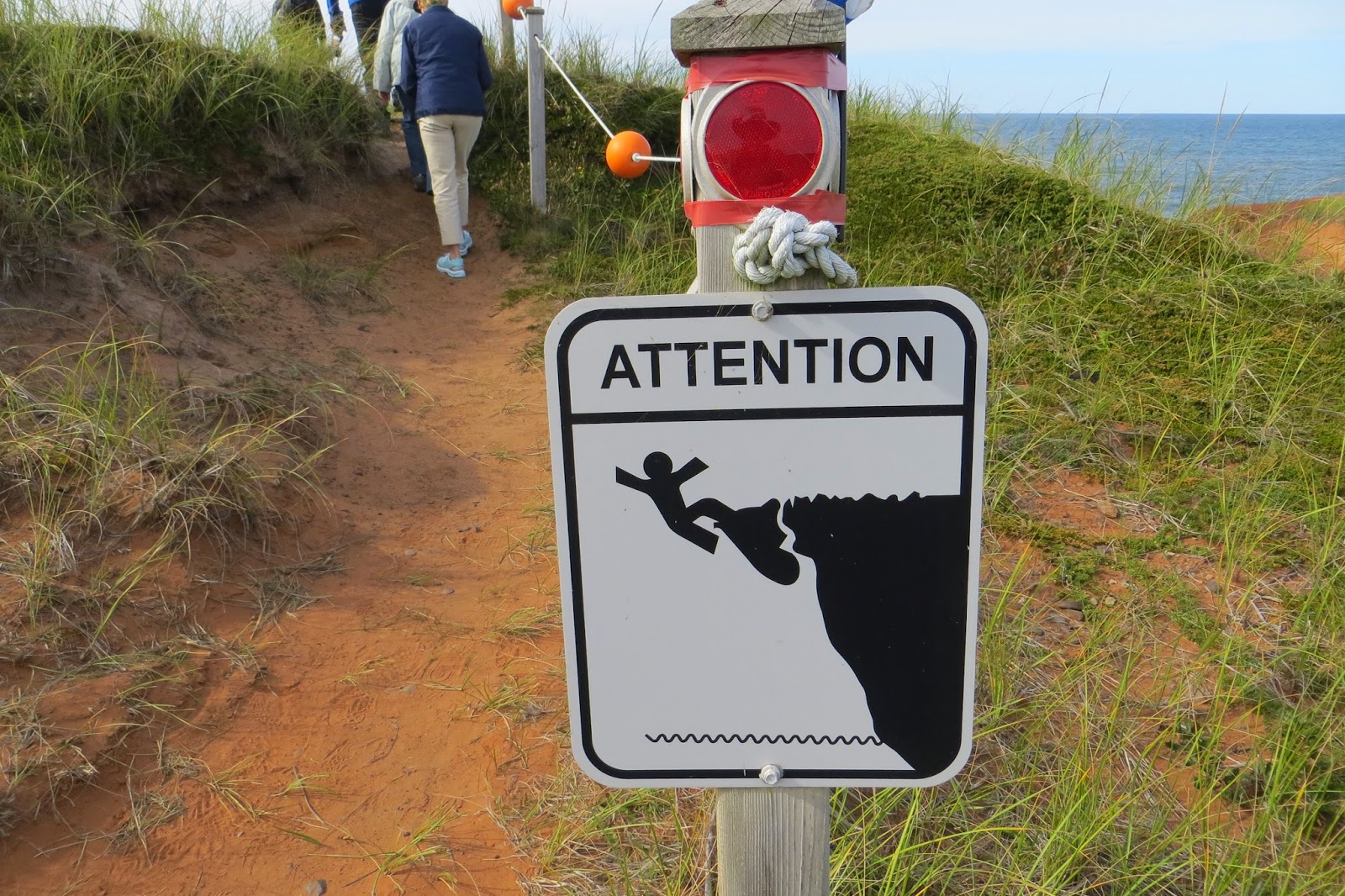
Back to our trip- The main event for us was a walk along the eroding cliffs of red sand.


During the evening Lisa, the Expedition Leader, pointed out that the Northern Lights were visible. Connie and I saw them but only as a glow on the horizon, about like the glow of Regency Square from our house. I saw a photo from one of the other passengers and it was the eerie green one usually sees.

9/14 Gros Morne National Park

Overnight we headed north in the ship and awoke at a little town called Woody Point on the edge of Gros Morne which is a very remote and beautiful national park and a UNESCO Heritage Site, back in Newfoundland. The morning activity was a "strenuous" hike up a mountain for some beautiful views.


That's our ship in the far background. Connie took the afternoon off which was a good move since it started raining. I went on a level hike for another 3 or so miles. The best part was seeing a moose up very close. A handful of moose were introduced here in 1904 and now there are 105,000 of them.


9/15 L'Anse aux Meadows/ St. Anthony

That night the ship moved further north up the western peninsula of Newfoundland to come to L'Anse. This is an archeological site where in the 1960s a husband and wife team uncovered a true Viking outpost  from about 1000 CE. The area is divided in two with one part being the Viking structures and then the second a Viking outpost recreated from Norway so one can see the parallels and learn from reenactors.


We went over to the site from the ship in school buses, the same ones that had taken us to the trail heads on the previous day. Hmm, this is early morning on a school day and yet we had school buses for transport. That confirms to me there aren't many kids in school. On the way from Gros Morne to L'Anse one of the school buses we rode in hit a moose. Look carefully at the photo and you can see moose hair:


In the mock Viking village there was a model Viking ship which some reenactors sailed over from Greenland in 3 weeks. The guides told us the Vikings would have made it in 9 days. So much for modern seamanship.
Next we had a Viking feast complete with a mock "thingg" meeting (what the Icelanders called their councils), then some free time in which Connie and I struck off on our own for an unsupervised hike up a 476 step mountain. Then we went back to the town of St. Anthony to the Grenfell museum. Grenfell was an amazing man who brought medicine to the fishing families of NL and Labrador. He was well connected and raised a lot of funds, wrote a bunch of books including one about his survival after being thrown out of his boat into the icy water and using his sled dogs for protection, founded a hospital that is still going, and ended up on a stamp and memorialized in a stained glass window at the National Cathedral in DC along with Jesus and Louis Pasteur. Who knew?


9/16 Twillingate
This was another beautiful day with a very fresh breeze and clear skies, a little cooler than the earlier ones. Twillingate is a small town somewhat similar to Joe Batt's Arm on Fogo. The first activity was a trip to Prime Berth where a former cod fisherman David Boyd has collected everything he could find to recreate an old cod fishing staging area. He also put on a demonstration of filleting and salting cod and then recited one of his poems- "I am a Fisherman". We bought his book. Look up prime berth.@xplornet.com. The bucket on the left of the photo is where he puts the livers which dissolve into cod liver oil.


Then a small group went for a hike along the rocky cliffs of the island. We weren't in pain but it was a good hike.


 Here's Connie at our rest spot at the highest point on the trail:


After lunch it was to sea again to go to St. John's. Along the way we had one very close look at a fin whale and several more distant sightings. It always amazes me how long it takes the whole length to rise and then fall when they come up for air.

9/17 St John's
As we were coming into St. John's I managed to put my foot in my mouth with the Captain and the Canadian pilot, but why repeat idiocy and lack of tact here?
We had the last of our 5 major hikes to Signal Point, which is where Marconi broadcast the first transoceanic radio signal and which is marked by a castle like structure in honor of Queen Victoria.


We saw this woman gazing at sea- after yoga or waiting for a sailor?

For the rest of the afternoon we wandered downtown St. John's, including a visit to a Tim Horton's, which is now famous as the company Burger King is buying to move its headquarters out of the US to save taxes.

9/18 Travel home
Uneventful except for the Newark TSA's interpretation of liquids, gel and jellies (on the positive side, I saw Connie lose her composure for one of the very few times in 30 + years) and on time. I'd like to go back for this whole itinerary all over again.

Friday, June 13, 2014

Another long weekend in the mountains in 3 parts

Part One- June 5-8, 2014

Connie and I went to Lexington to attend Bob and Barbara Priddy's daughter Kendall's wedding at their house on Brushy Hill on the 7th.

Reservations for wedding guests were saved at Col Alto, the local Hampton Inn. Connie and I learned from our Greenbrier weekend that Teddy and Ann Parker G's new venture, the Georges in Lexington, formerly the Alexander Withrow House, had 5 bedrooms open and we jumped over there at Teddy's invitation. We were supposed to be kind of guinea pigs and try things out.

The link, which I will have to come back to later to establish because the web site is not quite ready,  will take you to Gordon's beautiful photos of the Georges. We were on the third floor in room number 4 which is high enough off the street so there isn't any car noise and had great views of Old George and a bit of the Lee Chapel.


I had scheduled a meeting late Thursday afternoon with the current W&L students holding the Elisabeth S. Gottwald Scholarship at W&L, who both happened to working in the same psychology lab this summer. We met them at Elrod Commons and had a great chat about why W&L for these two northerners, about student life in general, and about their various activities. Lindsay is in the class of 2015, a psychology major, and a key player on the women's field hockey team. She found W&L from Maine thru her sister who went to VMI. Emily is in the class of 2016- these are the first two students to be awarded the scholarship. Emily is a neurosciences and music major and is in charge of the lab where they are working this summer. She was attracted to W&L because it would let her pursue both of her interests and do real research as a freshman. Both came across as wonderful girls and made me pleased that they hold the scholarship.


After that meeting, Connie and I went back to the Georges where we had made dinner reservations at Haywood's  (named after AP's Dad) restaurant and where the chef had told us he wanted to try some new things on us. It was a small plates dinner of about 6 or 7 courses and with all kinds of new tastes and combinations of things which I could never have conceived of. My two favorites were the shrimp taco and the pate (I would never order pate) made from pork and with home made mustard.
We were the only diners in the restaurant- there was a VMI alumni association board or something similar to that cocktail party going on at the same time.

One last comment about the Georges- the staff was super friendly and helpful. Thomas Burke is the manager, Tina is helping them get started. Our waiter is a student at Southern Virginia U, formerly known as Southern Sem, and is having his second child on the 4th of July, so Connie knitted him a baby blue baby hat. Later I ran into the chef on the street and asked him how he was doing. His response- "living the dream".
The next day (Friday) I went fishing on Buffalo Creek with my super fishing guide John Roberts (see Part Two) while Connie made a road trip up toward Raphine and then Brownsburg to visit a knitting store.

Dinner that night was at the Southern Inn- very good, and very casual, but a step down.

Saturday was a work day (getting ready for teaching English to the Russkis in Siberia) for Connie so she went to the library in Bridgewater while I went to the Project Healing Waters fishing event for wounded warriors at the 3 contiguous properties on Mossy Creek (mine, Stump's, and Bob Fitch's). This was my second year attending and it is very heartwarming. Beyond that, this little effort has raised about $750,000 for Healing Waters and veterans in 7 years!!

Saturday evening was the wedding. It was a perfect night and a perfect setting.


The wedding took place on the east side of the house and then the west side was set up for the buffet and there was a band stand where The Hot Nuts, or some group which licensed the famous name were playing. It was a clear night and there was a long hill up to a beautiful view of the valley, VMI and W&L. Connie and I caught up with several old friends. There were wedding dogs, multiple wedding photographers, and even a drone circling overhead taking pictures. Bob and Barbara were very happy.
On the next morning there was a getaway breakfast at Evans Dining Hall at W&L complete with W&L trident waffles. Kay and Richard Clary and several others were the hosts.

Part Two- Fishing Journal Buffalo Creek, Friday June 6

There had been rain earlier in the week and John was a little worried about muddy water but it cleared as the day went on. John and I had our usual equipment problems as we got started- slipped knots, broken  leaders, lost flies. I think I missed 20 fish, and, in a variant of Dennis' accusation that I missed the bonefish because of a "trout strike", John accused me of using a "bass strike". we tried 5 or 6 different spots on his stretch of the creek, including a couple of very deep holes, some ledges and some still water with success at every one. In sum, I probably caught 20 fish between 11 and 4 pm, all up from 14 inches, the biggest a good 22 inches, using nymphs and streamers. 


I got a couple of bites on a dry fly but no catches. In addition I caught a few smallmouth bass, sunfish and a rock bass.

Part Three- Wild and wonderful West Virginia, June 8-10

John and Deborah invited us to come with them after the getaway brunch to the condo in Glade Springs, WV. Glade is about 70 miles further west from White Sulphur, so about 255 miles from Richmond. It's a long haul but well worth it. Glade has three golf courses (John and Deborah's condo is on one of them), is owned by Jim Justice, owner of the Greenbrier too, sits on a big gorge of Glade Creek, and has an 80 acre lake in addition to many ponds as water hazards.
The first day we just lazed around and had some great burgers from the grill for dinner.
Connie and I took a long walk around the property the next morning and then DJ and I went paddle boarding and kayaking on the big lake.


More lazing around for the rest of the day capped by a serious corn hole game in which the Gs came from way, way behind to win- probably the pinnacle of my lifetime athletic achievement. For the evening's entertainment John and I got on the internet and googled old bands like Jay and the Techniques and watched what You Tube had to offer. James Brown and Little Stevie Wonder looked good and Joe Cocker is still stoned.
In the morning Connie and I took a longer walk in the opposite direction and then hit the road for home.
All in all, a varied but very much enjoyable, very long weekend.