Special Edition of Where in the
world...- Relatively short history of Russia for Michael and Beth
The trip you are about to go on is a
truly great opportunity to see some small fraction of the world’s largest
country (1/6 of Earth’s land mass, and maybe more if Putin brings back some of
the former Soviet Socialist Republics to the fold), to interact with some of
its people, to begin to understand the Russian approach to life
(which is pretty fatalistic to me), to see a new religion and its beautiful
architecture, to get some insight into why Russians and vodka go hand in hand,
and to view where some of human history’s greatest events took place.
Your trip starts in St. Petersburg
and ends in Moscow. Russian history doesn’t exactly go with that flow- it
starts in the hinterlands with wandering Slavs, Finns, and Vikings; it then
moves thru places you won’t see but may wish to see on another trip (Novgorod
and Kiev in particular); it eventually focuses on Moscow with the early tsars
(Ruriks), then it moves to St. Petersburg at the center with Peter the
Great (near the beginning of the “Romanov” dynasty which started in 1613, and
why I used “ ” around Romanov will be explained later) through 1917, the fall
of the Romanovs, and the rise of Lenin and the Communists, and then it switches
back to Moscow for the Soviet era and afterwards. In fact St. Petersburg’s
names reflect a lot of this history- St. Petersburg thru the 300 years of Romanovs, then
Petrograd with World War I (thought to be less German sounding), then Leningrad
for the Soviets, and after 1991 by popular vote of its citizens back to St.
Petersburg. For this write up, I am going to abbreviate St. Petersburg,
whatever its name at the time, as StP, Peter the Great as PtheG, and Catherine the Great as CtheG.
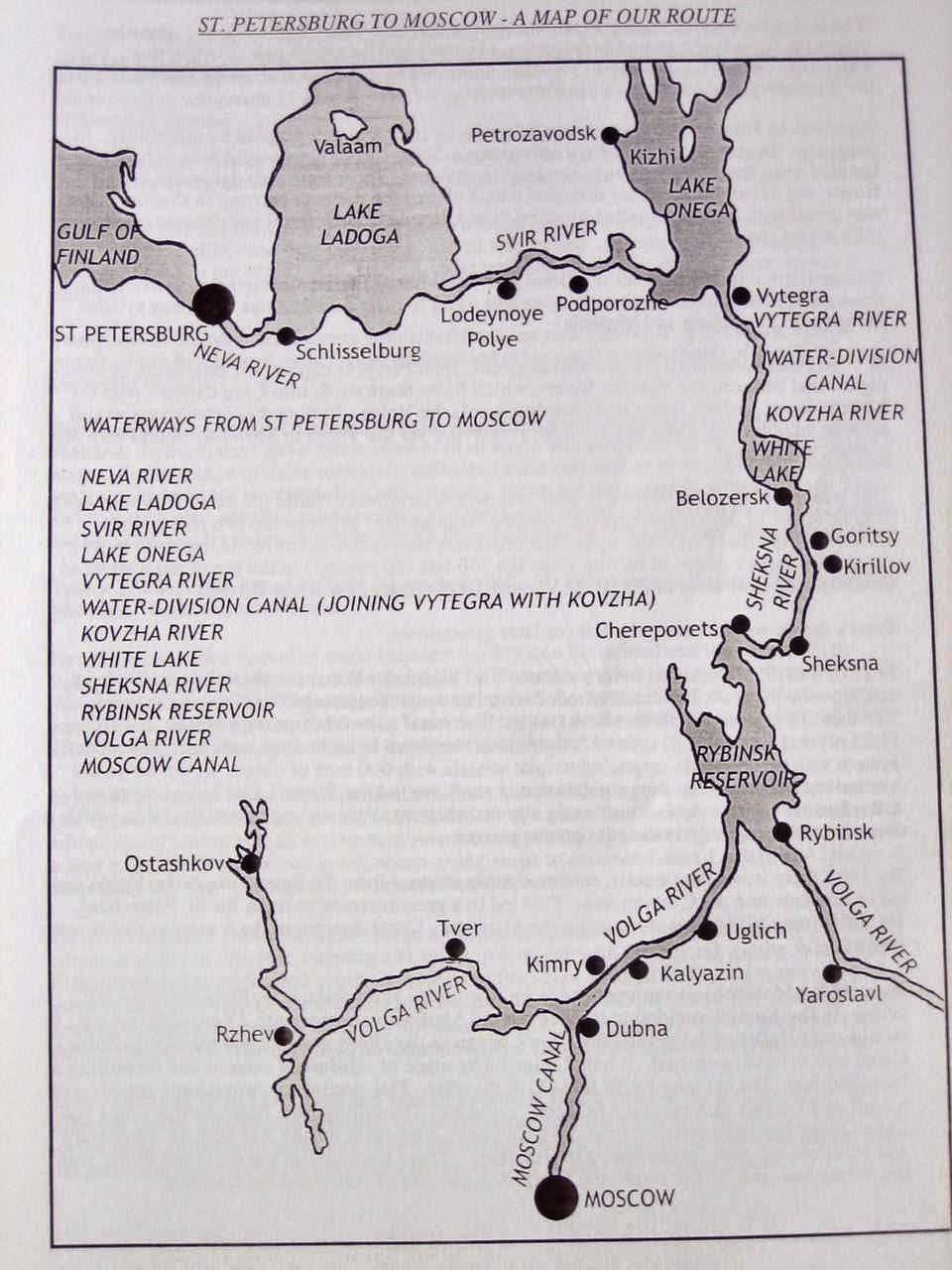 |
| Map of the route you will generally be taking |
You should know from the start that this is not a natural waterway system. Using slave labor Stalin changed the flow of the rivers and connected the Volga to the northern lakes and the Neva River. Look for a church steeple sticking up above the water midway in your trip.
What that little geographic
paragraph did not address was Russia’s position in Eurasia- part in Europe and
part in Asia. This shows up in the history too. From the 1200s through the mid
1400s the rulers in Russia were actually, to varying degrees at different
points in time, vassals of Genghis Khan and his Mongol/Chinese descendants.
Probably the countries that have been Russia’s sworn enemies for the longest
time through history are Sweden and Turkey (the Ottoman Empire). This leaves
out a lot of wars with Lithuania and Poland, both of which were on top at times
but mostly carved up and subjugated by Russia. On the Asia side, think of all
those “istan” countries that used to be Socialist Republics. The dividing line between Europe and Asia is the Ural Mountains and the town that is most famous near this artificial line is Yekaterinburg, which is where the last tsar and his family were shot, then thrown in a well and then had acid poured on them by the Bolsheviks in 1917.
Before getting into timeline kind of
history, there are a few other things for you to digest and keep in mind as you
think about Russia-
Item 1. About 44% of the population
of Russia was serfs in 1860, the year before they were freed. This means they
were poorly educated, if at all, and very medieval superstition oriented. (For
reference in the US at the outbreak of the Civil War, our population was about
10% slaves.).
Item 2.The Russian people have
suffered unbelievable horrors over the years. Imagine having a ruler called
Ivan The Terrible. Invaded by Napoleon. Moscow burned by Napoleon. 1.7 -2.25
million military deaths during WWI. 20 million military deaths during WWII. The Leningrad Siege for 900 days through 3 Russian winters and a daily ration of a slice of bread that was about 50% sawdust. And
then the body count during Stalin’s rule from 1927-1953:
"1 million imprisoned or exiled between 1927
to 1929; 9 to 11 million peasants forced off their lands and another 2 to
3 million peasants arrested or exiled in the mass collectivization program; 6
to 7 million killed by an artificial famine in 1932-1934; 1 million exiled from
Moscow and Leningrad in 1935; 1 million executed during the ''Great Terror'' of
1937-1938; 4 to 6 million dispatched to forced labor camps; 10 to 12 million
people forcibly relocated during World War II; and at least 1 million arrested
for various “political crimes” from 1946 to 1953.”
Addendum in 2017 as we "celebrate" 100 years since Lenin's Russian Revolution- Communism cost Russia about 55-65 million people.
Addendum in 2017 as we "celebrate" 100 years since Lenin's Russian Revolution- Communism cost Russia about 55-65 million people.
Item 3. The Russians have almost always had an authoritarian ruler. All power concentrated at the top during the times when
there was a tsar and then orders came down through a huge bureaucracy from the
tsar. With the Soviets, Russia replaced the tsar on top with a Politburo and
then had a similar bureaucracy to put those orders in effect.
Item 4. While Russia’s population is
decreasing due to a low birth rate and low life span (both probably due to
vodka in large part), and while we sometimes dismiss Russia as a superpower since the
dissolution of the USSR, Russia still has enough nuclear weapons to obliterate
all humanity. And Russia feels like it gets no respect. You will probably
wonder how Putin has been reelected
even though he has made mincemeat out of the notion of a democracy in Russia,
or whether the Russkis support him. Imagine a family with all its
squabbles. And then envision how that family comes together in a united front
when attacked or disrespected from the outside.
Item 5. When you see the remnants of Soviet style housing and hear about the food shortages and waiting in line, you can understand the fall back to vodka and the general feeling of hopelessness.
Item 5. When you see the remnants of Soviet style housing and hear about the food shortages and waiting in line, you can understand the fall back to vodka and the general feeling of hopelessness.
 |
| Soviet era apartment building |
History in a nutshell=
Early settlement by traders,
fighters, farmers; Slavs, Vikings, Finns.
Vikings probably give the land the
name Rus.
 | |
| Kvosch for drinking vodka or mead |
 | |
| Viking at the Crossroads (Vasnetsov, 19thC) |
900 AD- Kiev in what is now Ukraine
is the center of power.
988- Vladimir is the ruler. He wants
to unify his lands under one religion and sends his guys out to report back
about Catholicism, Greek Orthodoxy, Judaism, and Islam. Although there was
undoubtedly a marriageable Byzantine (Greek Orthodox) princess involved, the
story goes that he rejected Rome due to a distant pope who had power over kings, rejected
Judaism because he wanted to eat pork and didn't like circumcision, rejected Islam because he enjoyed vodka, and settled on Greek Orthodox
which evolved into Russian Orthodoxy. St. Cyril, a monk, comes to Russia
and adopts the Greek alphabet into the Cyrillic Greek looking alphabet which evolved into what
the Russians use today. (However Church documents use an older, more Cyrillian
alphabet called Slavonic.)
 |
| Cyrillic or Slavonic? |
1250 or so to 1450 or so- Mongols
move in and require tribute from the Russians. Era of the Khanate.
Mid 1300s- rise of Moscow as the
home of the Grand Prince. Kremlin means fortress. Many Russian cities have
kremlins; Moscow’s is most famous.
Mid to late 1500s (about the same
time as Elizabeth I in England)- Ivan IV= Ivan Grozny=Ivan the Terrible=
Ivan Majestic or Awesome= the first Tsar. Known for a 7 year reign of terror.
Territorial expansion toward the Caspian Sea on south and into Siberia in the
east. Kind of like Henry VIII in England, Ivan had 7 marriages- his wives kept
dying on him.


1581- Ivan kills his son and heir
apparent and his pregnant wife. Ivan’s last wife had a son Dmitry which the
church did not recognize. (Above painting by Repin, 19th C.)
Then the Time of Troubles before
Romanovs get established as next dynasty.
1605- Boris Godunov (you might hear
about an opera named for him), on his way to trying to become
tsar, probably arranges the convenient murder of Dmitry, Ivan’s last son
in Uglich. You will visit Church of the Spilled Blood in Uglich on your trip and you will laugh when the guide
tells the story of how Dmitry was supposed to die. Highly improbable and
it cost Boris his job and aspirations eventually.
A recurring theme in Russian history
is that in unsettled times someone steps up and claims legitimacy by being some
ruler who has been killed previously.
Early 1600s- a couple of false
Dmitrys and then the first Romanov tsar (Mikhail) in 1613.
Mid 1600s- Time to mention the
Cossacks, who lived in the Ukraine area and then out to the Caspian Sea along
the Dneiper and Don Rivers. Basically an unruly bunch who would be soldiers for the tsars some of the time and then become offended and ally with
the Polish or the Turks against the Russians. Famous as horsemen. Note the topknot.
 |
| Cossacks writing a letter to the Turkish sultan (Repin) |
1682- Sofia, the sister of a young
Ivan, the apparent next tsar, takes over as Regent. Since Ivan is not all there
mentally, Peter, his younger half brother is co-tsar with Sofia behind the
scenes. There is a double throne you will see in Moscow which has a screen
behind it so Sofia could tell the young boys what to say. Sofia eventually
plots to take over for herself, Ivan dies, and Peter with the army behind
him takes over. He sends Sofia to the Novodevichiiy Monastery which you will see
in Moscow. (Sofia Painting by Repin, 19th C.)

Late 1600s to 1725- Peter the
Great, 6 feet 7 inches, spent time in his early years incognito in Europe
learning trades such as making shoes, forcefully turns Russia toward Europe,
builds a Russian Navy, kills thousands of laborers in his effort to build St. Petersburg as
a “window to the west” out of a swamp. He was a real character. If you mentioned you had
a toothache around him, he would pull your tooth (and it might end up in a
museum called the KunstKamera which you can visit in StP). He made the nobles
cut their beards and move to his new city. Peter was a man always in a hurry,
always ahead of his fellows, and he changed almost every institution of Russian
life.
St. Petersburg (founded 1703) is
built on a group of islands at the mouth of the Neva River. The Neva is a short
river which begins in Lake Ladoga. One of your first stops after StP will be the all
wooden Kizhi church and monastery on an island in Lake Onega (lots of domes).

In StP you may see Peter’s
little wood and brick house where he first stayed and which now houses the
first ship of the Russian Navy on which Peter learned to sail, Peter’s Summer
Palace (a modest 8 rooms compared to what else you’ll see), and the Cathedral
of Sts. Peter and Paul inside the Peter Paul Fortress he built to guard the
river and act as a prison. The Cathedral has the remains of all the Romanov
tsars. Outside is a famous, somewhat controversial sculpture of Peter with an
oversized body and a tiny head.
 |
| Peter by Shemiatin at Peter Paul Fortress StP |
Peter’s drinking buddy, right hand
man, sometime general, and woman finder was Alexander Menshikov. Menshikov
built for himself the palace that is now the Kunstkamera (and houses other
curiosities collected by Peter- freaks of nature real and fabricated) mentioned
above and gave Peter his second wife who became known as Catherine I. In
another example of a recurring theme in Russian history, if the ruler doesn’t
like his wife and wants another, he would send the undesired wife to a monastery like
Novodevichiiy mentioned above and marry whomever he wants. This is what Peter did
with his first wife. Menshikov outlived Peter, fell on hard times with Peter’s
successors, was accused of corruption, and sentenced a cold life in Siberia with his family: (Painting by Surikov, 19th C.)

You will surely see in StP the great
statue of PtheG called the Bronze Horseman and given to the city by
Catherine the Great (Catherine II, 1762-1796, so not Peter’s wife). You will
probably see several brides and grooms near the statue- this is what Russkis
do (ask Mom). Pushkin, the most well known Russian poet, who basically made the
modern Russian language, wrote a poem called The Bronze Horseman about Falconet's statue coming to life and chasing a guy during a the huge flood of 1824 in
StP.

A brief word about Catherine, Peter’s
wife. She was a peasant and a bar maid, but she was also the only person who
could calm Peter when he was in a drunken fit or rage for some other reason.
She also outmanned Peter’s generals and saved the army in a battle with the Turks.
She and Peter had 10 children, only two of whom survived, both becoming
tsarinas. But before they came to the throne, Peter grew suspicious of his son
Alexis by his first wife. He had Alexis tortured and Alexis died in custody. (Painting by Repin, 19th C.)
History repeats (see Ivan above).

When Peter died in 1725, he
did not name a successor. There were six rulers between Peter’s death and the
ascension of Catherine II by military coup in 1762 . Catherine I,
PthG's wife,was “an illiterate peasant who died of drink, [daughter] Anna had a
reputation for cruelty and a liking for dwarfs, [daughter] Elizabeth is
renowned for the 15000 dresses … in her closet after her death, “ and
of the three men, one died as a baby, one died as a teen, and one was
overthrown by his wife. Elizabeth did get the Catherine Palace at Tsarskoe Selo
and the Winter Palace in StP (now the world famous Hermitage art museum which
you should see) built.
 | |
| Winter Palace, now Hermitage Museum |
The future Catherine the Great and
Peter’s grandson Peter had an odd marriage. Peter III liked to play with soldiers,
real and toy, even in bed with his wife, and affected to be more German than
Russian. He had a favorite mistress and paid little attention to Catherine.
Catherine was a German but became Russian, learning the language and converting
to Orthodoxy. She had several children with her lovers and one of the lovers
was very probably the father of the future Tsar Paul (so from him on they
really aren’t Romanovs any more…). Oops, and Catherine’s husband Peter was killed
in custody by the brother of one of Catherine’s lovers after the Palace Guard took over and installed Catherine in a coup d'etat.
Another of Catherine's lovers was Gregory Potemkin. Potemkin annexed much of Ukraine and Crimea for Russia by taking it from the Turks. After adding Odessa and more, Catherine wanted to visit. It is said that Potemkin erected fake villages and populated them with happy peasants to show off for Catherine (hence the expression "Potemkin villages" for something putting up a good facade). Potemkin's name comes up again in the 1905 Revolution in the name of the mutinous ship (and Eisenstein's movie).
Another of Catherine's lovers was Gregory Potemkin. Potemkin annexed much of Ukraine and Crimea for Russia by taking it from the Turks. After adding Odessa and more, Catherine wanted to visit. It is said that Potemkin erected fake villages and populated them with happy peasants to show off for Catherine (hence the expression "Potemkin villages" for something putting up a good facade). Potemkin's name comes up again in the 1905 Revolution in the name of the mutinous ship (and Eisenstein's movie).
CtheG had almost as
much energy as PtheG. She fought a couple of wars with the Turks, a
couple with the Polish and split Poland up three times, had
personal correspondence with Voltaire (this was the same time as the
American Revolution and the French Revolution) and had to deal with a Cossack
rebellion led by a man claiming to be her husband Peter III (history repeats). In StP you may
also see the Smolny Institute which Catherine established to educate noble
women and girls (and later became the headquarters for Lenin and the
Bolsheviks) and she added the Hermitage to the Winter Palace. CtheG and later tsars used their wealth to buy up collections of European art masters, and the Hermitage collection of DaVinci, Raphael, Rembrandt, Rubens, Matisse, Gaughin and others is unbelievable. Here's a serving tray from those days now in the museum:

Catherine the Great gets my vote as the best tsar or tsarina or premier or president the Russians have ever had.
Catherine the Great gets my vote as the best tsar or tsarina or premier or president the Russians have ever had.
 |
| Catherine the Great in Palace Guard uniform |
In addition to an inattentive
husband, Catherine also did not like her son Paul. Neither did the
Palace Guard regiments in StP when he became tsar, and they overthrew him in 1801
in favor of his son, Catherine’s grandson, Alexander I. Alexander probably knew
about the plot and is said to have regretted his role in it later. In StP you
can see the Engineer’s Castle where the drunken guards and noblemen did
the deed.
With Alexander the scene shifts a
bit since this is the time (early 1800s) when Napoleon is on the march, defeating
every European power in sight.
Alexander and Napoleon were enemies, then allies, then enemies again. Napoleon invaded Russia in 1812 and marched toward Moscow as the Russian Army withdrew, only giving him one full scale battle at Borodino (a draw). The Russian Field marshal Kutuzov, a very old, one eyed general, withdrew past Moscow instead of standing to fight at the heart of Russia.
But Napoleon's troops looted Moscow, burned it and then got very comfortable there for too long. With no army to fight at hand Napoleon decided it was time to go home and began to head back to France. But winter arrived early and the Russians had burned all the provisions along the way while they were retreating. The French had no winter clothes and then no food. Only about 20,000 out of 600,000 made it back to France.
Alexander led his triumphant Russian Army right into Paris. His soldiers in Paris would ask the restaurants for something quick to eat (in Russian, something like "bwistre") and the word "bistro" came into the language. Alexander ended his reign spending many years almost in monk like and mystical seclusion.
The 1800s were a golden age for Russia in terms of the arts but also the stresses of one man rule, the size and ethnic diversity of the empire, an unregulated industrial revolution, and pressures within the social classes led to the unraveling of the Romanovs reign:
In 1825 there was the Decembrist Revolution in St. Petersburg which led to the Tsar Nicholas I's soldiers firing on his own men. Dostoyevsky ends up in the Peter Paul prison and is pardoned only as the firing squad is about to execute him. Tsar Nicholas I has a policy of Orthodoxy (religion), Autocracy (one man rule) and Nationalism (watch out ethnic minorities).
Arts: Pushkin, poetry and stories; Gogol, short stories; Dostoyevsky and Tolstoy, novels; Glinka, Mussorgsky, Rimsky-Korsakov, and Tchaikovsky in opera, ballet and orchestral music; and Repin and Surikov in painting.
As you can probably tell, I really like the historical paintings by these Russians. It started with Bruillov's Last Day of Pompeii (1833), a mammoth canvas which, when shown in StP, had people standing in line for days and women fainting. It is now in the Russian Museum in StP, where there is also Pushkin's statue. If you have time and can visit either this museum or the Tretyakov Gallery in Moscow, they are well worth the visit. I am tempted to list Surikov's great paintings but I'll just say look up his Feodosia Morozova and ask Mom or me about it. The event portrayed led to our second marriage in Siberia. Regarding Repin, whose paintings I have shown a lot above, you should also see his painting at the Tretyakov Museum "The Unexpected Return" which portrays as surprise return home of a political prisoner from one of the Siberian camps.

1856- Another war with Turkey (The Crimean War) which drew in England and France and did not go well.
1861- Tsar Alexander II sets free the serfs, but in 1881 after many attempts nihilists murder him in St.P where the multi domed Church of the Spilled Blood was built (you can't miss it).
The next Tsar Alexander III was a bear of a man and a real hard liner (similar to Nicholas I- Orthodoxy, Autocracy and Nationalism). He is known to have held up the roof of a train car that had wrecked to give time for people to get out.
Alex III's son Nicholas was weak in comparison, but almost more than that he was unlucky. Right after his coronation in 1896 (Link to video: coronation ), Nicholas II had a banquet in a field near Moscow for his subjects. About 500,000 showed up and, when a rumor went thru the crowd that the tsar was giving away enamel cups with a gold coin in them, the crowd stampeded. About 1400 people were killed.
Like other tsars, there were pogroms against the minorities and especially Jews. This is the era of Fiddler on the Roof.
He got into the disastrous Russo Japanese War in 1905 which led to the Potemkin mutiny, riots and his token consent to let the people have a representative assembly (it never had real authority). See the first part of this blog's entry on our Trans Siberian trip.)
Nicholas II was totally in love with his Danish wife Alexandra and had a beautiful family of daughters. Then he had a son (the tsarevich) with hemophilia which was not well understood at the time. Not knowing what else to do, the tsarina brought in a mystical Siberian monk, Rasputin, who somehow stopped one of the boy's bleeding episodes. However Rasputin took advantage of his "in" with the tsar's family in many ways (especially with noble women) and drove a wedge between the family and the rest of the people.
 Nicholas II and family
WWI broke out with the tsar fighting with his cousin the king of England against his cousin the emperor of Germany. The Russians were not prepared for the war and were sending soldiers into battle with no shoes and no weapons (watch Zhivago). Since Nicky was at the front, the tsarina Alexandra was in charge at home with Rasputin whispering in her ear. A group of nobles in StP decided it was time to do something about Rasputin and lured him into a honey trap. They poisoned him with cyanide, then shot him and then wrapped him in a blanket and threw him in the Neva River in winter. It took all that to kill him. In StP you can visit the room in the Yusupov Palace where all this took place.
The war continued to go badly for the Russians; eventually there were protests, riots, and strikes, and then the tsar was forced to abdicate when the army switched to support the people. The ship Aurora, on display now in StP, actually fired shots at the Winter Palace in StP.
Lenin came back to Russia from exile (he returned to the Finland Station in StP), there was a struggle for power which he won and then the Soviet Era begins after the October 1917 Revolution.
The royal family is first under house arrest in Tsarskoe Selo, at the Alexander Palace outside of StP, but then they are moved inland to Yekaterinburg where they are murdered.

This next photo is a total fake but used by Stalin to shoow he was friends with Lenin:

Lenin dies, there is another struggle for power and a few murders, Stalin ascends in 1923, and the horrors of his rule begin.
World War II: the slaughter of Stalingrad (Enemy at the Gates) and the siege of Leningrad (StP) by the Nazis.
Stalin dies or is murdered in 1953.
This is my example of the Soviet era along with the apartment photo shown earlier . This was taken in Yaroslavl where you will be going. Along taken in 2010, it exemplifies the classic Russian saying about the Soviet government: they pretend to pay us so we pretend to work.

Alexander and Napoleon were enemies, then allies, then enemies again. Napoleon invaded Russia in 1812 and marched toward Moscow as the Russian Army withdrew, only giving him one full scale battle at Borodino (a draw). The Russian Field marshal Kutuzov, a very old, one eyed general, withdrew past Moscow instead of standing to fight at the heart of Russia.
 |
| Kutuzov |
But Napoleon's troops looted Moscow, burned it and then got very comfortable there for too long. With no army to fight at hand Napoleon decided it was time to go home and began to head back to France. But winter arrived early and the Russians had burned all the provisions along the way while they were retreating. The French had no winter clothes and then no food. Only about 20,000 out of 600,000 made it back to France.
 | ||
| Napoleon's retreat |
Alexander led his triumphant Russian Army right into Paris. His soldiers in Paris would ask the restaurants for something quick to eat (in Russian, something like "bwistre") and the word "bistro" came into the language. Alexander ended his reign spending many years almost in monk like and mystical seclusion.
The 1800s were a golden age for Russia in terms of the arts but also the stresses of one man rule, the size and ethnic diversity of the empire, an unregulated industrial revolution, and pressures within the social classes led to the unraveling of the Romanovs reign:
In 1825 there was the Decembrist Revolution in St. Petersburg which led to the Tsar Nicholas I's soldiers firing on his own men. Dostoyevsky ends up in the Peter Paul prison and is pardoned only as the firing squad is about to execute him. Tsar Nicholas I has a policy of Orthodoxy (religion), Autocracy (one man rule) and Nationalism (watch out ethnic minorities).
Arts: Pushkin, poetry and stories; Gogol, short stories; Dostoyevsky and Tolstoy, novels; Glinka, Mussorgsky, Rimsky-Korsakov, and Tchaikovsky in opera, ballet and orchestral music; and Repin and Surikov in painting.
 |
| Tolstoy by Repin |
As you can probably tell, I really like the historical paintings by these Russians. It started with Bruillov's Last Day of Pompeii (1833), a mammoth canvas which, when shown in StP, had people standing in line for days and women fainting. It is now in the Russian Museum in StP, where there is also Pushkin's statue. If you have time and can visit either this museum or the Tretyakov Gallery in Moscow, they are well worth the visit. I am tempted to list Surikov's great paintings but I'll just say look up his Feodosia Morozova and ask Mom or me about it. The event portrayed led to our second marriage in Siberia. Regarding Repin, whose paintings I have shown a lot above, you should also see his painting at the Tretyakov Museum "The Unexpected Return" which portrays as surprise return home of a political prisoner from one of the Siberian camps.

1856- Another war with Turkey (The Crimean War) which drew in England and France and did not go well.
1861- Tsar Alexander II sets free the serfs, but in 1881 after many attempts nihilists murder him in St.P where the multi domed Church of the Spilled Blood was built (you can't miss it).
The next Tsar Alexander III was a bear of a man and a real hard liner (similar to Nicholas I- Orthodoxy, Autocracy and Nationalism). He is known to have held up the roof of a train car that had wrecked to give time for people to get out.
Alex III's son Nicholas was weak in comparison, but almost more than that he was unlucky. Right after his coronation in 1896 (Link to video: coronation ), Nicholas II had a banquet in a field near Moscow for his subjects. About 500,000 showed up and, when a rumor went thru the crowd that the tsar was giving away enamel cups with a gold coin in them, the crowd stampeded. About 1400 people were killed.
Like other tsars, there were pogroms against the minorities and especially Jews. This is the era of Fiddler on the Roof.
He got into the disastrous Russo Japanese War in 1905 which led to the Potemkin mutiny, riots and his token consent to let the people have a representative assembly (it never had real authority). See the first part of this blog's entry on our Trans Siberian trip.)
Nicholas II was totally in love with his Danish wife Alexandra and had a beautiful family of daughters. Then he had a son (the tsarevich) with hemophilia which was not well understood at the time. Not knowing what else to do, the tsarina brought in a mystical Siberian monk, Rasputin, who somehow stopped one of the boy's bleeding episodes. However Rasputin took advantage of his "in" with the tsar's family in many ways (especially with noble women) and drove a wedge between the family and the rest of the people.
 | |
| Rasputin, Alexandra, the 5 girls and Alexis, the tsarevich |

WWI broke out with the tsar fighting with his cousin the king of England against his cousin the emperor of Germany. The Russians were not prepared for the war and were sending soldiers into battle with no shoes and no weapons (watch Zhivago). Since Nicky was at the front, the tsarina Alexandra was in charge at home with Rasputin whispering in her ear. A group of nobles in StP decided it was time to do something about Rasputin and lured him into a honey trap. They poisoned him with cyanide, then shot him and then wrapped him in a blanket and threw him in the Neva River in winter. It took all that to kill him. In StP you can visit the room in the Yusupov Palace where all this took place.
The war continued to go badly for the Russians; eventually there were protests, riots, and strikes, and then the tsar was forced to abdicate when the army switched to support the people. The ship Aurora, on display now in StP, actually fired shots at the Winter Palace in StP.
Lenin came back to Russia from exile (he returned to the Finland Station in StP), there was a struggle for power which he won and then the Soviet Era begins after the October 1917 Revolution.
 | |
| Lenin in front of Smolny by Brodsky |
 | |
| Lenin's desk at Smolny |
The royal family is first under house arrest in Tsarskoe Selo, at the Alexander Palace outside of StP, but then they are moved inland to Yekaterinburg where they are murdered.

This next photo is a total fake but used by Stalin to shoow he was friends with Lenin:

Lenin dies, there is another struggle for power and a few murders, Stalin ascends in 1923, and the horrors of his rule begin.
World War II: the slaughter of Stalingrad (Enemy at the Gates) and the siege of Leningrad (StP) by the Nazis.
Stalin dies or is murdered in 1953.
This is my example of the Soviet era along with the apartment photo shown earlier . This was taken in Yaroslavl where you will be going. Along taken in 2010, it exemplifies the classic Russian saying about the Soviet government: they pretend to pay us so we pretend to work.
Khruschev, the Cold War, Brezhnev, then Gorbachov.

Gorby knows the Soviet system is broken and tries to reform. He opens things up and then can't get the genie of freedom back in the bottle. There is a coup by the old line in 1991 but it fails. Then Yeltsin, then his handpicked successor, Putin (watch Putin's Way on PBS Frontline Jan 2015).
So I hope you see there is more to Russia than mushroom domed churches like St Basil's in Moscow-

Additional resources :
Movies- Alexander Nevsky; Battleship Potemkin; Attack on Leningrad (about the siege in WWII); Anna Karenina (I prefer Greta Garbo version); The Last Station (last days of Tolstoy); The Way Back (escape from Siberian work camp); Dr. Zhivago (1900 +/- thru early Soviet times); Happy People (documentary about life in remote Siberia); Russian Ark (one shot documentary- Winter Palace from Catherine to Lenin); Reds (1917 Revolution); Leviathan (man against the machine); East West (soviet life) and even comedies- Window to Paris, Irony of Fate, Good Bye Lenin.
CD classes- Mom has a series on Russian Literature and one on Russian History.
Literature- nothing short but all those listed above are great. Add Chekhov for plays and short stories and add Anna Akmatova for some sad, moving poetry. Just for fun, I'd suggest Gorky Park and Polar Star- 1990s murder mysteries set in Russia.
History- again, nothing short. Robert Massie's books on Nicholas and Alexandra and on CtheG are the best. Also 900 Days by Harrison Salisbury about the siege, and Lenin's Tomb by David Remnick about the end of the soviet era.
Music- Tsar's Greatest Hits and anything by Tchaikovsky, but especially the Russian Symphony, the 5th and 6th symphonies and the violin and the piano concertos.


