Prior to the WLU trip to NZ, there were two books recommended- one on modern adaptations to Māori myths, and one on the history of NZ. C opted for the myths and I chose the history.

Throughout this trip, the fishing trip, and the BR trip, we were constantly reminded of the various aspects of the history so I have chosen to summarize that before describing the things we did and places we saw.
It starts with the break up of Gondwanaland, the supercontinent. NZ slowly drifted apart from all the other landmasses and life evolved very distinctly there since it was virtually impossible for it to be influenced by evolution elsewhere. There were no dinosaurs, one smallish semi dinosaur like lizard, no mammals except for a couple of small bats. Birds were everywhere, and without predators except for a huge eagle many developed as flightless birds. The largest were several species of Moas, which resembled Ostriches or emus but much, much bigger. Fast forward lots of years, lots of evolution, and lots of geologic and volcanic activity (since NZ sits right on two tectonic plates banging together or pulling apart).
Polynesians, who originally are thought to come from Taiwan, were great celestial navigators and gradually branched out farther and farther from their home islands. Probably around 1250 AD some Polynesians settled on the North Island first and then the South Island. The South Island was a bit cold for these former occupants of the tropics. The Polynesians over time developed a new culture which became Māori. In addition to growing sweet potatoes they hunted and made the Moas and many other big birds, including the eagle that ate Moas, extinct. No Moas were around when Europeans arrived.
In the 1600s a Dutchman Abel Tasman saw NZ, named it, and
had some interaction with the natives but eventually sailed off. In 1769 on his
first voyage Captain James Cook came by and landed with his team of scientists.
I believe Cook came back on his next two voyages too. NZ was on the map for the
Brits. On one voyage, maybe the first, Cook brought a man from Tahiti with him
who, even though there had been no or little interaction for 500 years, still
could talk to the Maoris.
It took many years, many settlers, and many voyages but the British developed the notion that they should turn NZ into a mini England. So they introduced rabbits which overran the islands, stoats (weasels or ferrets) to hunt the rabbits which overran the islands too and contributed to killing off the kiwis and other flightless birds, red deer which also overpopulated, brown trout in the 1840s, and rainbow trout about 40 years later.
In time the Māori and the Brits came into conflict. But first the Māori who acquired muskets from the Brits had old scores to settle with other Māori. Then the battle became one between Māori and their view of land ownership and the Brits with their view of land ownership and their rights as subjects of the King.

I’ll quit here on the history other than to add that the Europeans brought diseases that killed off a lot of the Māoris. I believe Australians brought another pest- the possum which is more raccoon like than the opossum we have. The Māoris are both integrated and culturally distinct now due to mixed marriages. NZ folks we met say that 20-30% of the population is Maori. Counting the mixing it might be more. The Māori language (after acquiring a written alphabet from the Brits) is now listed on street signs and most other places like Spanish is at home. Māori legends are alive. As an example, many of the huge and beautiful lakes have no recreational activity on them because such is tapo, ie they are sacred to the Māoris.
WLU alumni trip- Feb. 8 - Feb. 20, 2024
C and I arrived on the 6th so we could get acclimated to the time change. It was pretty confusing to leave on the 4th, totally skip the 5th, and land on the 6th. Our route took us from RIC to ATL to LAX to Auckland. It is about 45 minutes into the city from the airport. We arrived at our hotel, but the room wasn’t ready. After getting settled a bit and taking a walk to Albert Park to get a bit of exercise, we caught up with a couple of others in the group and had dinner and an early bedtime.
The next day was totally free. C and I did a morning walk
on K (too long to remember) Road and a park and had breakfast at an artisan
bakery that was quite good.
Later we joined up with J’s brother to go to the
Auckland Museum (as good as last time but without the great docent) and then
the amazing flower garden and park. Maori marae in the museum:

We almost saw a unique owl like bird with the strange name of morepork in the fern area of the gardens. C and I found a nice lunch spot downtown on a side street- it was so good we wanted to go back again but couldn’t find the side street a second time.
On the 8th the WLU activity started with The America’s Cup Sailing Experience at the harbor and right next to the Maritime Museum which we also visited. We had a good breeze and put up the spinnaker. The captain let the customers steer a bit. The sailboat we were actually did race in the cup series in the 90s and then was used to train crews for a while.


The group got acquainted that night at dinner. I think we were a group of about 16, with a core of 6 friends from Roanoke, J from WLU and her brother, and the rest from assorted places. Only 6 were actually grads.
Feb. 9- We took our coach to the Waitomo area for a walk down into the glow worm caves, have a sip of kawa kawa tea, and then a visit to a kiwi hatchery where they grow kiwis from the egg until they are better able to survive in the wild- stoats, feral cats, rats, possums and dogs are the main threats. In the wild about 4% of eggs make it. Maybe 60% made it before all the hazards arrived with Māoris and Europeans. We learned kiwis are nocturnal. At the end of the day we were in Rotorua and had dinner OYO (on your own) on Eat Streat there. My burger was so tough I never tried another one on the whole trip.
While I am on food, they serve lamb shoulder here which is so tender it falls off the bone and was wonderful. We never saw lamb chops. They have salmon but never saw trout served. The kiwis serve almost every meal and dish with a bit of beet root, which they make into a relish which is tasty and sweet. Last on food, in the Maritime Museum there is a full size more modern America’s Cup sailboat on display- the ENZA which stands for Eat New Zealand Apples, and I support that- crunchy and sweet.
For the 10th we were still in Rotorua visiting the geothermal area and the Māori Cultural Center (all about their art such as carving). Then we went for a meal at a Māori marae (meeting house with carvings all over the inside and the outside). I had to give the welcome from our group back to the elder. When the elder spoke to us he talked for about 20 minutes in Māori and then did not translate. It was a fine meal followed by some Māori dancing. C and I went to the Redwood Forest after that (brought in to see how they’d grow (they did great) but in the end they decided not to farm them so it is now a huge free national park.


Sunday the 11th was a travel day- coach back to Auckland, flight to Christchurch (South Island) and then another coach through the Canterbury Plains to Lake Tekapo. One of our group let us all know that that night the International Space Station would pass right over us and we watched it- pretty cool.

The 12th took us to the Mount Cook area, passing beautiful lakes and stopping at the The Wrinkly Ram for purchase of some merino wool, possum and silk thread for a stocking cap. At Mount Cook we went to the Edmund Hillary Center (he was a kiwi and trained for Everest on Mount Cook). Saw an amazing documentary about NZ Air Rescue conducting a complicated rescue of a climber who fell, slid about 50 yards, and then slipped into an italic “L” shaped crevasse with a constriction mid-way. Later the group went for a hike on the Hooker Trail. Lots of swinging bridges. J the athletic coach in our group commented on my ability to cross the bridges without touching the handrails, but the last one was too much for my limited skills. Back home this was Super Bowl Sunday so we were following the game as we walked. It was a great walk as well as a great game.


Back on the bus for the next day’s drive through the South Island wine region (Gibbston Valley) and into Queenstown. Our hotel was right on the lake and C was in heaven with the trails on either side of the lake. Dinner was OYO.
The place to eat in QT is Ferg’s Burger Bar. The line to get in was at least 100 feet long even at 10 am. We did not try but we found Mrs. Ferg’s Gelato with no line some distance away and visited it at least twice. We did a lot of wandering in town and found… Guess what- a good yarn store!
2/14 was a great day- We went on the Shotover Jet boat which was both scary and exhilarating, and then across the lake on the Earnslow (a coal fired steamboat) to a BBQ lunch. This is where I had Happy Birthday sung to me.

What we didn’t know on setting up this trip is that, besides being there for Valentines Day, we were there for the NZ Waitangi Day Holiday (celebrating the first treaty between the white settlers and the Māori) (each of which had very different ideas of their rights under the agreement), and Chinese New Year as well as SuperBowl Sunday. Big crowds of Asians everywhere we went for a few days.
On the way back to town on the Earnslow, C and I sat next to a Chinese family. The mom and 8 year old daughter spoke good English and we had a nice conversation. I was ready for Jill’s Ali to marry the little girl whose English name was Chelsea. They were very curious about how many children and grandchildren we had and about high status US Colleges. Chelsea was taking the precursor to the International Bacchalaureate program. They were going home that night to start school the next day. For dinner OYO we went to a place called Finz at the lake harbor. C had her best meal of the trip- a halloumi salad and I had delicious raw tuna. By the way the Māori word for eel is tuna but this was real tuna.
Thursday, Feb. 15- Coach ride from QT along the lake Lake Wakatipu and then to Te Anau, the start of the Milford Track and the doorway to Fiordland National Park. We each got in a walk (I went to a bird sanctuary to see a Takehe, a bird thought to be extinct but then found in a remote region and now nursed back to a few hundred breeding pairs). After dinner C and took another walk to see the place where trout were introduced to NZ.

The 16th was a tough day but well worth the effort. It started with a 15 minute helicopter ride to a hut way up on the Kepler Track. At the hut there is a kea (big parrot) ready to get into every unattended backpack. We hiked up for about a mile then back down to the hut for a bag lunch and then down 5 miles to the shores of the lake through an amazing fern forest. Lots of silver fern which the Māoris used as pathway signage and now Air NZ uses as its logo on the planes.

At a scenic overlook spot near the hut up top C turned to Jim next to her and said “C’mon over here for a photo!”. I quietly said to her “You do know that’s not your husband?”. We all got a good laugh over that.

Early morning day for the Milford Track and Sound. Drive along the lake, water taxi over to Sandfly Point, and 3 miles out and 3 miles back along the Track. Pretty level path at this point and very much a drippy NZ rainforest. The big falls is Giant Gate and we matched photos of now and 2016’s view for C and little B. Then we took a boat ride around the fjord. This is the place where, rainfall dependent, you can see more than 2 dozen waterfalls from just turning around while standing in one place. Sandflies or black flies have been with us for a few days but were thickest here on the Milford. Sun, wind and motion keep them away.

On the 18th some went for more hiking on a steep trail along the Routeburn Track. Several of us opted for the several small hikes and waterfalls alternative. We had an enthusiastic young guide, the hikes were spooky, green, and beautiful, and we met another kea who was interested in the rubber tires on the car in front and the roof of our minivan. Back to QT and a free day there the next day. We went to Arrowtown which was the site on one of the small NZ gold rushes and has the remains of an old Chinese mine workers settlement. We took a local bus there which is always interesting.
That evening we had a joyful farewell dinner. This group had blended and bonded more than any other group I have ever been in on. I hope that feeling comes across in the photos.

Tuesday the 20th- End of WLU tour, domestic Air NZ travel from QT to Auckland to Rotorua. Amazing that there is no airport security for small town domestic Air NZ flights.

Other Māori words I have picked up- nui means big, wahine
means women, tane means men, tinni means soda cans (like for recycling),
Patiriki means Patrick, wai means lake or river or water, Kia ora means welcome,
tapo means taboo. NZ in Maori is Ateoroa. There is no "d" in Maori.
Three days of trout fishing in the North island of NZ Feb. 21-23, 2024
C and I were in Queenstown at the end of our W&L trip- after briefly seeing some of the North Island but mostly the South Island from Queenstown (Shotover Jet boat ride) to Lake Tekapo to Mount Cook to Te Anau with partial treks along the Milford Track, the Kepler Track, and four or five smaller trails.
On the 20th we flew to Rotorua and rented a car to get to the fishing site. This was my first time driving on the left side of the road and I admit I was very nervous. While I am on the subject of driving here, I admit that once, much later in this trip, I got in the car on the left side and sat there for about 20-30 seconds before it dawned on me there was no steering wheel. Luckily Connie wasn’t there to notice this little slip. Our rental was an MG, which I have not seen or heard about since 50 years ago in college.
The drive was about 50 miles straight into an area the rental car agent was surprised about. She said not many people go into the Wririnaki region (“Wr” in Māori is pronounced like an “f”).
Off we went not knowing what to expect. There were lots of dairy farms, some private and some funded by Fonterra which asked the cattle farmers to triple the size of their herds and feed them on palm kernel provided by Fonterra and then to sell the milk powder to Fonterra at rock bottom prices for the Chinese market. I learned all this later from my fishing guide who was a rabid environmentalist (and who shouldn’t be a rabid environmentalist living here?).
There was lots of planted pine forest and then pine harvesting along the road too. My guide told me sometimes they get cyclones here that pick up the pine leftovers (slash) in a wall of death and blow it down the hills.
Here the pests to the birds like kiwis are introduced rats, feral cats and introduced stoats (weasels). I saw one crossing the road. There are signs saying the road gets “frosty”, there is “wandering stock”, and report all “wallabies”, another introduced species. New Zealand law says you should run over a possum in the road (another introduced species) rather than swerve. The Australasian Harriers are the buzzards of NZ and eat up the roadkill, while some folks gather the possums to skin them for use mixed with merino wool as fabric for socks, hats, and gloves.
We got to our “farm stay” which is like a B&B ultralight and very rustic. We arrived after dark and learned we should have stopped at the nearest grocery store 20 plus miles back over a very curvy road to get some breakfast provisions. There were 2 cabins, one occupied by the guide and his departing clients and the other for us. The host was very friendly and had six dogs (used for boar hunting) of which we saw two. It was extremely quiet and I wish I could have stayed up at night to see the stars without ANY background light, but I was “knackered” each night.

First day of fishing (Feb. 21) we went on the Wririnaki down the road about 20 minutes from our farm stay. The stream was very rocky and slippery and I went full into the river right off the bat. The trout are super wary and have vision all around except for 12-20 degrees right behind them. This really is closer to stalking and hunting than to fishing. This is why my guide had recommended camo clothing. I have none. I bought a camo hat but it just looked too doofus. Maybe this explains my lack of luck. I got three rainbows after floundering around all day and losing many more. Guide comment on my first hook up- “have you ever caught a trout before?”. And after this day I felt like it was a just question. My best moment was when we had been watching this one fish move around but return over and over to the same place. The guide said I had an 80% chance of catching him on the first cast but 20% if I could get a second chance. After dragging line across fish all day and spooking them in many other ways, I cast and actually hooked and caught him on the first try.

On the way back we stopped at a national park (all parks are free in NZ) campground to look at a nearby waterfall. We saw 4 Czechs staying in a camper van. The guide said the Czechs rent a van and stay two or three weeks, dib dab nymphing in four different bits of fishing territory each day, spending nothing except maybe on beer and a little food. I think this contributes to the wariness of the fish but nothing to the NZ economy.


For the second day we took a helicopter up to pure heaven. I was awake half the night worrying about whether this was a safe move or not. Not a sign of a human ever being there, only fresh stag tracks. This was on the Waiau River and a tributary. I didn’t fall this day but I also couldn’t catch a fish. I hooked up about 5 times. I lost one very nice one by stupidly trying to stop a run by holding the line on the butt. At the end we were pressed for time to get to the heli pickup spot so my guide was trying a few casts while trudging through the river at a good clip. At one place he stopped and made several casts. On the last one a rainbow bigger than anything he or I have ever seen jumped all the way out of the river to try to eat the dry fly (cicada). He was so big we both were startled and almost lost some body fluid.
Here was beautiful but no luck. If weather had come in and the chopper couldn’t land to pick us up, it was night in a shelter and waiting for better weather or an 8 day walk out. Luckily it was clear. I brought one chocolate bar to get through the night. It melted but inside the package.)


For the third day (Friday Feb. 23) we went to Rotorua where the fish try to get out of the heated up water (it was COLD to me) in the lake by going up one of 4 creeks. We stopped at a place on the Awahou River where you can mostly just look at the stacked up fish in the creek. To fish those fish you had to go out into the lake which had drawn a crowd of anglers. Made me wonder why all those guys weren’t at work. We moved on to the Waititi River which has a deeper entrance from the lake. The fish were stacked there too. So were the anglers, so much so it reminded me of shad fishing on the banks for the James. Most everyone knew each other and all knew my guide. This was purely nymph fishing. I caught a couple that the guide hooked and then caught four or five on my own. One guy across the bank said “good hook set” and my guide said “nothing wrong with you reflexes”. It was a very satisfying day.
I saw a totally new way of flyfishing with the double flies rigged the opposite from the way we do it. Too hard to explain but might be worth a try on big water.
One last note- the game police came by and checked everyone’s licenses. They were so cordial. I asked the guy who checked me if you need to have a hook to be called fishing. He said if you have a rod capable of catching fish you are fishing. Good answer to an old question for me.
The kiwis have this custom that really threw me the whole time.Without knowing a person at all they will say "Good job Mate" or "OK Mate". I don't know anyone but I am their "Mate". It felt strange.
BR trip- Feb. 25 - March 3
When planning this NZ trip, we talked about avoiding as much winter weather as we could. C insisted I work out some fishing days and then she found the perfectly timed BR trip to finish out the vacation. In retrospect we should have been taking a winter month off for years.
When I finished fishing in Rotorua, C met me there for that night and then travel by plane from Roto to Auckland to begin the BR part. This travel day was Saturday the 24th. We spent the night of the 23rd at the P Hotel, near Eat Streat and broke our lazy pattern with a couple of moderate walks along the lakeside. I think I got bit by bedbugs the night of the 23rd. Our Roto flight was scheduled for late afternoon, the last flight of the day. It was running a little late but we eventually boarded. Then we were delayed a bit more. After a while the attendant came on the mic and said the plane had a "screw loose" that Air NZ could not fix then and so the flight was cancelled. What to do??
After some thought we determined the only choice was to take an Uber to Auckland. We found another couple to jam into the car with us and a somewhat willing driver. He drove fast. It got dark. He did not know Auckland. We watched him make a huge wrong turn that took about 15-20 minutes to correct. Then the hotel we needed was on the quayside in the harbor with a difficult entry that we also missed. But we made it and we met the BR group on time early the next morning.
This next day was MISERABLE. We had a one hour shuttle to
the Hauraki Rail Trail. As soon as we started fitting out our bikes the heavens
opened with a steady rain. It was a 17 mile ride (which I hated)- the trail was
wet with pooling water; it was gravelly; there were several road crossings,
gates and a one kilometer tunnel and I had a hard time getting off my bike for
each one. I was never so glad to see a finish line. I also wore tan/whiteish shorts and striped undies that everyone got to see through my wet pants.

But, then we had another hour in the van to Pauanui on the Coromandel Peninsula and the Puka Park hotel. There the day turned around- our room had a washer and dryer!! Everything we could think of from the prior 10 days got washed.
This trip by BR is listed as “multi-adventure” and we proved it on the following day. At Hahei Beach, we took sea kayaks into Mercury Bay to land at Cathedral Cove. Both of these places were named by Captain Cook in 1769. Further on we could have gone to Cook’s Beach or Shakespeare Cliffs but we went back to the hotel for very steep, rocky, slippery hike overlooking the Pacific within walking distance of the hotel.

I forgot to mention today’s lunch which was at a winery famous also for its pizza. The meal was amazing. Dinner was at the local beach club across the bay from the hotel- also excellent.

By this time the BR group had pretty much gelled. The two leaders were Jeremy (who knows John from our Dolomite trip) and Ms Congeniality Jessie. She provided the team enthusiasm, and C says she looks like Mandy Moore.

The group is from all over the US- Seattle and Tacoma, NYC, San Diego, Oregon, Alexandria, Cape Cod. No lawyers; lots of bankers; one OB nurse practitioner; a meteorologist.
Feb. 28- we left the Coromandel on the way for our third time to Roto. Part of the way there we met up with a guide from Kiwi Dundee to take us on a 2 or 3 mile hike with elevation in an old gold mining area. There was a train track laid at an unbelievable grade to haul product and waste out. It reminded me of the mine scenes in Indiana Jones and the Temple of Doom. The new hotel in Roto was small and charming- the Black Swan.

Back to the bikes- As part of the trip from Roto to Lake Taupo (the cone of a huge volcano), we biked along the road to Waikite Thermal Pools. It was a beautiful sunny day. After swearing off bikes after that first rainy day, this one brought me back. The course was all on the road but it was a very lightly travelled (and pretty hilly) farm road. Once I got started I determined not to stop until the end because if I did stop I might not get back on. The BR guides who ran ahead of the bikers in the van were totally amazed that I finished first. When C found this out she said “I am so proud of you”- that made my day.

There were several thermal pools with temperatures ranging from just under boiling on the incoming side to about 85 degrees in the real pool. Lunch was fish and chips poolside.
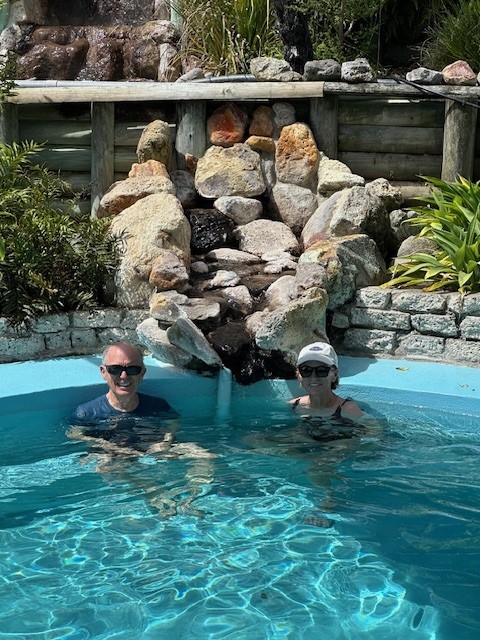
After traveling the rest of the way to the Taupo Hilton, we were on to another Māori cookout (hangi) and dance experience. The Māori chief was named Snow and was part Scottish and all showman.
Thursday, Feb. 29- We all had a slightly earlier start today because we went whitewater rafting (class 2-3) in rafts on the Tongariro River, one of the feeders to Lake Taupo. Our guide was big tall Finn who somehow got my mini group and our raft pulling in the same direction and managed to help the other two rafts when they got wedged into the rocks. It was an 8 mile, 2 hour float, with wet suit and jackets. After lunch (poke bowls in town) it was bungy time for those brave souls (bungy swing for C) and then a 2 mile hike along the Waikato River, the single outflow from the lake to Huka Falls. The color of the water may actually have been better than the blues and greens of the Bahamas.
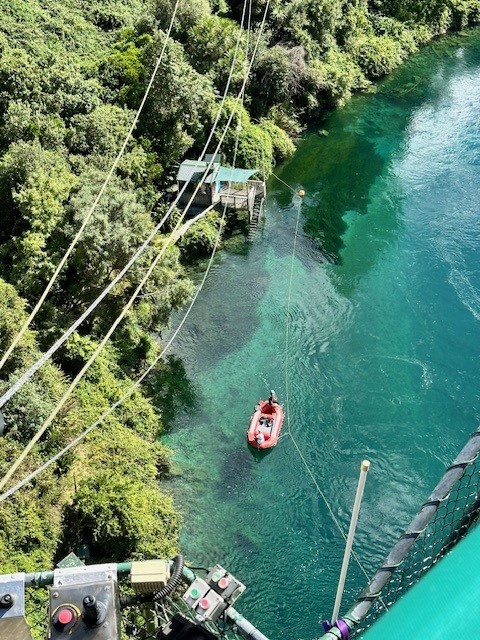

We then left Taupo in the morning ( March 1) to drive to the Hawke’s Bay area and Napier, the art deco capital of NZ. It was a beautiful clear warm day for biking 18 miles along a huge lagoon (I think formed by the giant 1931 earthquake) and then following some tight confusing directions into town. Again I finished first after starting nearly last because I wanted to get off the bike. Luckily it was all pretty level. Lunch OYO and a brief wander about Napier. The hotel for the last two days was the Mangipapa where the rooms were huge. MP is a working farm with sheep, apples (ENZA) and other produce grown on site.
March 2 was another biking day but I figured I had ridden three days without incident and didn’t want to press my luck. This was possibly C’s best day- sunny for biking, a visit to a honey store for some manuka honey souvenirs. Lunch was at a very interesting place called The Figgery. Every serving had figs of some sort. We went for a walk in the fig growing area and learned all about figs- 900 varieties, some need pollination and some don’t and some need it when starting off, how plants live 800 years, how the pollination takes place by a microscopic wasp specific for each variety. Wow, who knew? The proprietor didn’t know anything about figs when he retired from city management in Australia. He and his wife decided to grow about 10 fig trees and play lots of golf. Now he has 15000 trees and little to no golf. That night farewell dinner.


March 3- A hike to Te Mata Peak (about two miles UP) and then air to Auckland.

A very long March 4- leaving Auckland at 3 pm, landing in LA at 9 am the same day, home by 6 the same day. The day did not start well- at 3 am NZ time Sunday night, so technically Monday March 4, my phone rang and woke me to tell me I had a doc appt on Tuesday at 8 am. I knew it and didn't need to be reminded while I was 000s of miles, 18 hours of time difference, and deep asleep away.
Addendum: new birds seen-
Black Swan Cygnus atratus 2/10/2024 and other days N and S Island
New Zealand Scaup Aythya novaeseelandiae 2/11/2024
Pied Shag Phalacrocorax varius. 2/11
New Zealand Dabchick Poliocephalus rufopectus. 2/15
Paradise Shelduck Tadorna variegata. 2/15
Grey Duck Anas superciliosa 2/15
Black Shag. Phalacrocorax carbo. 2/23
Little Black Shag. Phalacrocorax sulcirostris 2/27
Reef Heron. Egreta sacra. 2/26 Cathedral Cove
Pukeko. Porphyrio porphyrio 2/9 and 2/24 and more
Weka Gallirallus australis. 2/17 at Milford track landing
Waxeye also known as Silver Eye 2/26 Cathedral Cove Variable Oystercatcher. Haematopus finschi 2/26 Coromandel beach club dinner
Pied Stilt Himantopus leucocephalus 3/1 Near Napier in lagoon
Black-fronted Tern Childonias albostriatus 2/12
Red-billed Gull Chroicocephalus scopulinus 2/17
Black-billed Gull Larus bulleri 2/14
Southern Black-backed Gull Larus domicanus 2/14
Australoasian Harrier Circus approximans 2/11 and 2/17 and many other
New Zealand Pigeon Hemiphaga novaeseelandiae 2/27
California Quail Callipepia californica 2/23
Kea Nestor notabilis 2/16
Welcome Swallow Hirundo neoxena 2/6 and 3/1
Fantail Rhipidura fulginosa 2/15 and 2/21
Tomtit Petroica macrocephala 2/17
Australian Magpie Gymnorhina tibicen every day
NZ Robin Petroica australis 2/18
Tui Prosthemadora novaeseelandiae 2/29


