Adventures in Greater Russia
Trans Siberian Rail trip September
4- 22, 2013

Monday September 2- Labor Day-
Richmond to San Francisco via Detroit
Our house sitter and boarder Antonina gave us a ride to
the airport at 7:30 for
a relatively civilized departure time of 9:30. We arrived SFO about midday and
took the Marin Airporter to San Rafael where Jill and Ravenna met us. Graham
fixed salmon on the grill for dinner. Ravenna was feeling a little sick after a
long weekend in Wine Country with a mix of other children belonging to Graham's
Northwestern friends. Poor Ravenna would go from acting her usual perky self
when her medicine was working to very cranky when the medicine was wearing off.
Tuesday September 3- Theron's first
birthday
We spent the day at home with Jill,
Ravenna and Theron. It was another up and down day for Ravenna, and Theron
seemed to be stuffed up too.
For Theron's birthday, he went for a well baby checkup and got four shots but
he took it in stride. B&C went to lunch at the nearby Whole Foods and came
to the conclusion California is very different from the East Coast. Billy
identified a couple of new birds in the backyard. For Theron's birthday, he got
a chocolate covered cupcake with sprinkles that Ravenna helped to make for him. He was
quite a mess after eating it. The kids went to bed early and Jill had a moment
to explain to us in much more detail what both of her jobs are all about.
Wednesday Sept 4-
Jill went to work early and Graham
and Ravenna gave us a ride to the bus to SFO. It was a 12 hour flight on Korean
Airlines to Seoul. The stewardesses were very polite, constantly bowing and
smiling. One of them handed B a glass of orange juice which happened to have a
hole in the bottom and so it spilled all over his pants. She was horrified and
all B could do was laugh. She spent a lot of time (Connie thinks a little too much time) trying to
dry the pants. The manager came by and apologized but B said it was not a
problem. The manager said the stewardess was very upset and B said to tell her
not to worry. He thanked B for his kindness.
KAL served dinner then turned off
the lights, then a while later turned them back on and served lunch and then
turned them off again for a few hours. We were very confused and got little
sleep. B watched a documentary about a lost Da Vinci painting and then The
Company You Keep with Robert Redford, Nick Nolte and another couple of aging
stars (Weather Underground radicals apprehended 30 years later). Then he
watched Admission with Tina Fey.
We landed in Seoul at about 6:30
(who knows what time it really was?) and observed life in the airport for a few
hours. There seemed to be a lot of young people who bought bags and bags of
things in the duty free store and then unpacked them into much smaller bags
before leaving. I later found out these were Chinese who come to South Korea to
get better quality cosmetics and things and then take them back to China.
Friday Sept 6- Vladivostok

We left Seoul on Vladivostok Air
(part of Aeroflot) at about 1:30 and landed in Vlad at about 5:30 after a two
hour flight-again no idea what time it really is. Nat Geo met us at the airport
and took us to the Hyundai Hotel in the center of town. It was about a 45
minute ride from the brand new airport along a brand new super highway (all
built to be ready for a global conference in 2012). We took a bit of a nap and then went
for a long walk around Vlad using our Trans- Siberian Handbook as a guide. Vlad
was different from what was expected- hills and big port somewhat like a
combination of San Francisco and Oakland; Soviet style apartments, some pre
Soviet business buildings in the central part; much fewer Asian looking people
even though the Korean and Chinese borders are close (our guide later told us
people from Vlad regularly take trains or buses across the borders to go
shopping); the churches we saw were new, the old ones having been torn down. We
saw the central post office, train station, house of the Brynner family (Yul
lived there), great views of the bays and the open sea. We tried to go to the
Primorsky (name of the region) Museum to see Repins and others on loan from the
Tretyakov Museum in Moscow but the museum was run down and the exhibit now only
showed Chinese art. We had lunch in a Russian cafe (borscht etc) and dinner in
an Uzbek restaurant. There were lots of small white butterflies and dragon
flies attending lots of weeds.
Nat Geo left us some chocolates, a
lacquer box, and a small bottle of Vodka in the room. The room had lots of space,
the strangest toilet we have ever seen, and good internet, so we got to touch
base with home one last time before the unknown connections on the train ride.
Saturday Sept 7- Vlad
It sure seems like a long time
before the Nat Geo part of the trip really starts.
We had read that as part of the
preparations for the global conference,
the higher ups had also decided to connect two major parts of the city (imagine
an upside down U with water in between) that had only been served by ferries
(except in rough weather) by bridge and then to build a similar bridge
connecting an island known as Russia Island to the rest of town. The last part
of the plan was to move all the universities in town (Far Eastern Federal and
Vlad State along with possibly others to new quarters on the island- they had
been spread out in lots of buildings around town (FEFU 40,000 students)). So we
decided to take a bus ride over to see the universities, figuring there would
be lots of students there, lots of coffee shops and book stores etc. It was bit
of an uphill walk to get to the indicated bus stop and later we found there was
one much closer to the hotel, and we took a one hour bus ride across both huge
new suspension bridges,
got a look at the aging Pacific fleet (no subs), saw lots of very sketchy
looking old Soviet style apartments and a couple of defensive forts on the
island. The bus gradually filled with students and we figured we would just get
out where the students did. We came up a hill and there was a stop where the
students exited the bus en masse. It looked promising in that the buildings were
brand new, there was a big sign up for the Pacific Meridian Film Festival, and
there was a line of cars entering. However it turns out there no coffee shops,
there was heavy security checking identification, and one needed student id or
a film festival pass just to enter the campus.
We got back in time from this
adventure to go to the Welcome Reception on the 12th floor of our hotel and
then to go to an excellent dinner in the Fish Restaurant. It was a long block
away from the hotel, but, given the age and infirmity of many of the travelers,
and, given the blind curves and traffic, NG had us ride a bus. The lesson from
dinner is that we will be well fed on this trip- multiple courses with each
meal, and so pace is important.
Connie’s notes from Vlad in an email
to the kids-
Arrived
on Friday morning after 22 hours in transit, including a long 7 hours in the
Seoul airport. Glad we came a couple days early, though, as we like the
down time before meeting up with the group. Vladivostok is an interesting
city but doesn't really cater to English-speaking people. Although signs
in English are frequently seen, there are no tv channels in this hotel and no
menus in English, at least in the three restaurants we tried on our own.
We've walked about the town and yesterday took a bus ride across a
recently constructed bridge to "Russian Island," where the
universities here are in the process of being relocated. After riding the
bus for an hour, we followed dozens of students to the entrance to the
university buildings, where we found it was necessary to have a pass to get by.
Explaining that we were tourists who just wanted to walk around did no
good; their concession was letting me take a couple photos of the buildings.
Turns out it's one of the locations for the Pacific Meridian Film
Festival, which opened yesterday. There were several films from the U.S.
but the only title we recognized was "Chasing Ice." Our hotel
is one of the registration spots and there is a big welcome sign hanging on the
front of the building, Anyhow, after failure to get past the guards at
the university, we caught the next bus and had another hour-long ride back to
town. Seems a long way away to for the students to travel for classes;
don't know if whether or not there are dormitories since we couldn't get by the
16-year old-looking guards/
Last
night we met our group of 20 other travelers, about half from California and
the others from the east coast. I am the youngest woman and Dad almost
the youngest man - but all except one seem fairly spritely (is that the word?)
and congenial. Michael, the daughter and son-in-law of one couple own a
farm-to-table restaurant in Brooklyn called "Grocery" - have you
heard of it? One guy named Pete is from Belmont, CA, near San Fran, I
think, and is an amazing 80-year old. He's traveling alone (I think his wife
died several years ago) but is sharp, interesting and has a great smile.
I wanna be like him at 80.
Sunday Sept 8- Vlad


Today we get on the train, but only
after a long day of touring town by bus. However each of the stops was very
interesting in its own way. First we went to a museum about the coastal
defenses around Vlad and went into a bunker with lots of bits of weaponry from
the two world wars. Vlad was never attacked but that may be because the defenses were so formidable.
Then we visited a very new and beautiful embankment by the bay which we had
somehow missed in our walk around town on our own on the previous day (probably
because it was finished after our book was published). There we walked thru
C-56, a Russian WWII submarine very reminiscent of Das Bot. Next the bus took
us on the very repetitive and complicated set of maneuvers on the new highways
to get to Eagle's Nest viewpoint high above the city. The hill seemed to be held up by cables which were
anchored into the hill further back and posed a significant tripping hazard.
The bay at Vlad is called Golden Horn because it reminded the old sailors of
Istanbul's harbor. It is very hard getting oriented toward where the open sea
is because of all the inlets, islands and hills. We then went to lunch at a
restaurant back near our hotel (and near the kitty cat bank we had used to
change dollars for rubles) and then off to the Far East Federal University
museum complete with guided tour by the museum director. He spent a lot of time
telling us about the history of human settlement in the area up until the time
of the Manchurians, and the artifact collection was very impressive- ceramics,
arrowheads, fish hooks, simple tools. There was also a rare book museum, a
history of the university museum, and a zoological museum which we quickly
walked through. The next stop was the cemetery, sadly very unattended,
where sailors and soldiers of other countries who came to the area during the Intervention
after WWI are buried along with local mafiosi who killed each other off when
Vlad opened up in 1990 (it had been a closed city because of the navy). Then on
the way to a drive by of the universities on Russia Island we passed some
examples of the mafiosi economics at work- they owned some land, built brand
new modern apartments on it but no one wants to live there because of the
severe wind in winter. And speaking of winter, the guide told us the new
suspension bridges close when the wind reaches certain velocity- One wonders
what the students do who happen to live in town and go to school over there
when this happens.
The train was running late because
it got delayed by flooding to the north. At about 7 pm the train crew had had
enough time to clean up from the prior travelers and was ready to receive us.
Our professor George Munro had
told us to sit in the room for a moment before starting to unpack and to see
all the spaces available. There did not seem to be much space at all but after
leaving a lot in our suitcases we managed to fit the essentials in and get
settled.
The welcome dinner was more than
adequate. We sat with a young couple not in our group but from Mexico and in
fact from the town we studied during the Don Quixote class. The train began
moving on time at about 8:45 pm.

Sleeping in close quarters and with
all the bumps and lights of a moving train took a while but we will get used to
it.
Monday Sept 9- Khabarovsk (the most
livable city in Russia according to the Handbook)
Arrived
at 7:45 a.m. and met our guide at 8:30. She was in her mid-60s, is a
university professor of linguistics, works as a guide on the side and was
excellent. We learned a lot about the city, a place I’d never heard of
until we signed on for this trip.
When
we stepped off the train, I noticed that our Nat Geo expert George Munro was
being interviewed and filmed by what we learned was the local TV station.
Evidently having a group from Nat Geo is a noteworthy event; I wonder if they
thought we were all scientists or at least a learned group of people. The
twosome followed us to the first stop on our sight-seeing morning, the scenic
overlook of the Amur River, and interviewed two of our group - including
me. I was simply asked my name, my impressions of the city and whether or
not I’d like to return someday. Easy questions to answer.
Back
to the tour - Khabarovsk is a city of about 600,000 people, built on three
hills and has three main streets. It is known as the capital of the
Russian Far East and is an expensive place to live. The city was closed
to foreigners until 1964, the year Japan hosted the Olympics. Khabarovsk
was on the travel route to Japan so decided to take advantage of all the people
who were attending and allowed them to pass through and visit as well. It
is located on the Amur (“muddy river with strong current”) River, which just a
month ago flooded higher than ever before, with the water level rising almost
25’, and in some areas homes and businesses were severely affected. The water has
now just started to recede.
Khabarovka
was a Cossack explorer who helped establish the first Russian settlements of
the Far East. He led two expeditions of the Russian Cossacks to the Amur
River in 1646 and 1649 and reported the beauty and possibilities of the
area. In 1858 a treaty was signed with China and the region became part
of Russia. In 1861 serfdom was abolished and many Russians and Ukrainians
moved into the area, seeking land and better living conditions. The
Trans-Siberian Railroad (1891-1916) further stimulated development.
Former
and current industries in Khabarovsk include production of military equipment
and machine tools, oil refinery, shipbuilding, pharmaceuticals, mineral
extraction, forestry, fishing and wood processing.
The
sites we visited on the city tour included:
- Assumption
Cathedral - blue obelisk-shaped spires. Built in 2001, it is a
replica of the original which was destroyed in the 1930s.
- Transfiguration
Cathedral - gold-domed - the third largest Russian Orthodox cathedral in
Russia (272’ tall, capacity 3000). Built in 2003.
- Memorial
to the fallen heroes of WWII from Khabarovsk. A 25’ semi-circular
marble wall curves around 20 equally tall panels on which are engraved the
names of 70,000 killed or MIA soldiers. An eternal flame burns in
the center.
- The
Local Lore Museum - exhibits of ethnic groups, local animals, a large map
of the region and a panorama of the Battle of Khabarovsk during the Civil
War, similar to the panorama we saw in Sevastopol.
We
returned to the train by 11, had a good lunch of olivier salad (crayfish tails,
duck, potatoes, peas, other veggies, mayo) and solyanka (yummy veggie
soup). George gave an afternoon talk “Introduction to Siberia,” then Tatiana (expert on board)
spoke on the history of the Trans-Siberian Railroad. Tea was at 5:30 with
a guitarist providing entertainment. Dinner 7:30- 9 p.m. Clocks go
back one hour tonight.
Tuesday Sept 10- On the railroad traveling
all day with a few stops to take on water and to switch engines
Observations of this part of
Siberia- We are now going almost due west and we are about as far north as we
will get. The terrain so far has been flat, a mixture of field (with mostly weeds
or natural, not cultivated) and birch forest. The leaves on the weeds and on
the birches are changing to yellow, more so the further west we get. The
mornings have been cool but warming considerably during the days. Today we have
our first cloudiness which has lasted beyond early morning. There are lots of
little rivers, especially compared to the huge and swift Amur which we crossed
yesterday (getting across it was a big impediment to the completion of the
railroad because of river flows north then east and thus has ice damming it up
in spring- when the upstream thaws and the ice breaks , it would take out the
wooden bridges), and swamps. Other than the small towns there really are no
houses or signs of people. We were told that Siberia is 80% of Russia but has
less than a third of the population. From what we have seen so far, I think
Siberia might have less than 20% of the population.
About the train, after a couple of
days we are used to the size of the cabin, maybe 7x7, and the bath, and
we have found a place or an accommodation for our things. Sleeping
has been bumpy, a little noisy, and a little lonesome in that the
lower berth is wide enough for two but not for all night. That said sleep
has been good. Yesterday the sun set about 8 o'clock and rose at about 7. I
would guess the days are getting shorter by about 20-30 minutes per week
now.
If I could use one word to describe
what I see out the window right now, it would be "empty",
meaning devoid of signs of people or animals or birds- just scrub brush and
birch trees; beautiful, serene, but empty.
Note- all day yesterday we had cell
service but none today.
Today’s
lectures:
History of Russian Tsars – Alla, prof on board for non NG folks
History of Russian Tsars – Alla, prof on board for non NG folks
Russian
lesson - Alla (not a great job, not prepared for so many people, song on
laptop not set to go)
Russian
Orthodox Church - George
DVDs
watched:
Siberia:
How the East Was Won - excellent
Ghengis
Khan - excellent
breakfast
- blini with tvorog and jam
lunch
- herring salad, beet salad
dinner
- vodka tasting with zakuski, golubtsi
Wednesday,
Sept. 11 - on board all day
We
woke up this morning 8 hours behind schedule because of a train derailment (!) last night; fortunately, several freight cars
rather than people flipped and no one was hurt. But - instead of arriving
at Ulan Ude in the early afternoon and possibly making a short visit to the
city center, we passed through at 8 p.m. And now the border guards will
arrive on the train in the middle of the night instead of 9:30 as was
hoped. The only time we got off the train was for about 10 minutes in
Chita; felt good to breathe fresh air and stretch our legs. I walked the
length of the train - 20 cars plus the engine: 12 passenger cars, 2
dining cars, kitchen, bar and 4 for train personnel - found out later that 2 of
these are sleeping cars, 1 for supplies and 1 for the generator.
The
landscape changed a few times during the day - fewer forests, more fields
(forest to steppe), more cows than so far, more habitation but all areas fairly
depressed, with soviet/primitive construction. The morning views reminded
me of Canada with tall pines and rolling hills, then later of California,
Mammoth Lakes area without the mountains, similar to the drive from Owens River Road
to Mammoth - forest and open fields. The weather was cool and clear this
morning, warmed up to probably 60-ish then became cloudy by late
afternoon.
Lunch
- shchi - yum! for
me and bean salad for B
Lectures
- Was Bolshevism Inevitable in Russia? Alla Kiseleva
Russia and Mongols - George Munro
DVD
- The Captivating Star of Happiness - about the Decembrists’ sentenced to to the labor camps
and the wives deciding to give up everything to join them there
Thursday,
Sept. 12 - Ulan Bataar
We
crossed the border into Mongolia during the night. We were awakened
twice, first so the Russians could check our passports, then three hours later,
so the Mongolians could do the same. It was startling to have the
unexpected bright lights in our eyes in the middle of the night - reminded me
of stories of Stalin’s time-
the knock on the door you have been dreading.
As
we got nearer to Ulan Bataar, gers (yurts) began appearing. These are the
portable homes of the nomads, circular in shape, which contain all of a
family’s possessions. The Mongolians have traditionally been a nomadic
people with open grazing for their animals (yaks, cows, sheep, goats, 2-humped
camels, horses- “5 snouts” (cows and yaks count as 1)). The government recently
passed a law which allows people to own plots of land up to a certain size with
the conditions that they register, pay a small fee, enclose the land and put it
to use immediately. This has changed both the traditional lifestyle for many
Mongols and the landscape, now filled in places with many types of fencing (tires,
wooden, concrete) to mark privately owned space.
The
population of Mongolia is about 3,000,000, with more than 1/3 living in the
capital city of Ulan Bataar. The rapid influx of people into the city has
far outstripped the ability of the government to provide housing and services,
with the result that gers and multi-story apartment buildings exist side by
side, providing a strange landscape. The city is crowded, there are too many
vehicles, and it seems unsafe to cross the road at any given spot.
First
stop - Gandan Buddhist Monastery, home to 200 monks (we saw about 6). Notable
were the thousands of pigeons (or so it seemed) covering the square in front of
the temple and people selling seed to feed them (why?). The whole scene
was new to us and we admit our knowledge of Buddhism is nil - so we understood
little of what was before us, including
- the
brass “wishing” or prayer cylinders which are turned in prayer (?)
- hundreds
of about 18” “female Buddha dolls,” a few of which had money in front of them, arranged along
three walls of the temple
- the
HUGE golden Buddha, 100’ tall, in the center of the temple
- outside the temple, 20’ golden feet of the new Buddha, maybe for a new temple


During
Communism, Stalin had 700 monasteries destroyed; some of the monks escaped and
lived in caves in the mountains near our lunch spot.
Museum
of Mongolian National History - B learned about the progression from Huns to
Turkic peoples to Mongols to Uighurs in the area. I enjoyed the ethnic
costumes but find all the weapons and jewelry and stones from museum to museum
fairly repetitious.
Got
on the road to Terelj National Park. After clearing the downtown traffic,
we drove on a new road until - surprise! - we ran into several rocks laying
across the road, signifying a roadblock and the necessity of turning back -
which the driver did by putting the bus in reverse for about 1/4 mile. Then
we used a bumpy, potholed from rain, gravel and dirt road, kicking up dust and
bouncing along on our way to lunch. Our lunch spot was at sort of a dude
ranch for Mongolians where you could rent a ger or stay in a small cabin.
The location was beautiful, looked to us like Wyoming, with tall rock-faced
hills on one side and a wide-open meadow all around. It reminded me of
Israel except green.
During
lunch we had a short exhibition of Mongolian music which included a flute, a
horse headed, two stringed fiddle and some throat singing. The flute playing
which involves circular breathing (in and out at the same time) has been
recognized by UNESCO as part of the national heritage.
We
then went to visit a family living in a ger- plastic floor, colorful painted
wooden supports and furniture, a men’s side and a woman’s side, a stove in the
middle vented through the roof, and a southerly facing door (in older days it
would have had a felt blanket for the door and an open fire fueled by animal
dung). Then there were some modern touches- the four year old child had on
rubber boots and spider man pajamas, there was a flat screen tv, and outside
there was a solar panel.


After
this we were running a bit ahead of schedule so we took off basically across
the meadows on a free for all road, with cars and trucks coming and going in
several directions at once, for a while until, in the middle of absolutely
nowhere and further from town than where we had been for lunch, there was the
world’s tallest equestrian statue- of Genghis Khan. Visitors are supposed to be
able to ride an elevator up into Genghis’ head, kind of like the Statue of
Liberty, but there was no power to the facility today.

After
a bouncy ride back to town and an end of day traffic snarl, we had dinner at a
very good Nomads restaurant, an hour of souvenir shopping at the state run
department store (a la Soviet times), and then back to the train.
One
side comment about the ride to the store and then the store itself- where is
anyone in this town over 30 years old? The bus stops seemed to have nothing but
young women as did the store, and the store felt like a Nordstrom’s- makeup
counters, brand goods. There was also thin screen tvs, lots of cashmere,
Playskool kids yard sets and a Cinnabon franchise at the very top.
All
Mongolians are supposed to know how to ride horses and the way the young who
have come to the city do it now is they get sent to live in a ger out in
the steppes with their grandparents during the summers. This tradition will
probably be gone in two more generations.
Added
note from Connie- The
day in Mongolia was as if on another planet -Buddhism, ger (yurt) life, Ghengis
Khan, other things we knew little about. We were out in the middle of
nowhere, after visiting a ger-dwelling family, when we came upon a 100' tall
silver statue of Ghengis himself, perched on top of a museum which was
unfortunately closed because the electricity wasn't fully working. Also
saw a 50' tall statue of a female Buddha goddess (?) in a temple, surrounded by
3 walls of little Buddhina dolls, hundreds of them. There is so much
about this religion I don't know.
In
the morning we go back through the long double border crossing and will spend
the rest of the train trip in Mother Russia.
One
more side comment from WMG- As we talk to the fellow travelers on this train,
it has become very apparent that most of them have some sort of tie to Russia-
a grandmother from Moscow, a grandfather who came over to the Far East of
Russia during the Intervention after WWI, parents who left Russia and moved to
Israel, and, as our Russki professor on board says, so so so.
Friday,
Sept 13- Naushki and Ulan Ude -
Much
of the day was spent crossing back into Russia from Mongolia -
- arrived
in Sukhe Bator for passport check at 7:15, took a photo (illegally?) of the border patrol saluting the
train as we departed an hour later.
- rode
for an hour through the border zone; noticed a barbed fence along the way
- arrived
Naushki, Russia at 12:30. Russian passport control personnel boarded
the train to check
our visas. This process took about 30 minutes but after it was
finished we were allowed off the train (in the light rain) to wander for
another 30 minutes. I made my way to the local “producti” and
bought some candy, just to buy something after looking around the small
shop.
- another
couple hours of sitting on the train while the engines were changed
Finally,
we were told to be ready to disembark the train as soon as it stopped in Ulan
Ude at 4 p.m. - and they weren’t kidding, as the train pulled away after only
a 5-minute stop. Our NatGeo group was taken by bus to a village of
Old Believers about 45 minutes away.
Back
in the mid-1600s, the head of the Russian Orthodox Church, Nikon, decided that
over time many variations had slipped into Russian church practice which differed
significantly from the Greek Orthodox rituals. With the agreement of the
tsar, Nikon order changes to return to the more original “correct” Greek
worship. There were five major changes at this time to return to the
earlier way:
- crossing
oneself with three fingers instead of two
- the
manner of bowing (full prostration instead of from the waist)
- the
spelling of the name of Jesus (Исус instead of Иисус)
- polyphony
in singing was eliminated
- the
direction of going around the altar: clockwise or counterclockwise
The
Old Believers stuck with the “old” (Russian”) traditions, while the reforms
closed the gaps between these traditions and the original Greek rituals. Then,
in true Russian fashion (says B), the “new” believers, those that agreed with the
reforms, tried to force them on the Old Believers, with severe penalties (like
death) for not conforming. Some of the Old Believers simply left, with a
minimum of possessions, to the White Sea (north) or the Buryat area (east).
The
houses of Old Believers are made of wood with the shutters usually painted blue
so that when they are closed at night, a bit of heaven is seen inside the
home. The place we visited was a family compound, with a small 5-room
residence, a few storage sheds with wood, tools, an inside storage area for
other tools, coats, etc., a building for cooking and eating, an outhouse
(decorated with painted blue dolphins) and a large garden with the biggest
cabbages I’ve ever seen.


Our
hostess, Olga, seemed ready and eager for our visit; she greeted the bus with a
huge smile as we pulled up to the compound. We think she might be 75-80
years old, was colorfully dressed in traditional garb with a unique headpiece
adorned with pins and jewels. Around her neck were several strands of
amber beads, which we learned were passed on from mother to daughter; the fewer
the daughters in the family, the more amber each daughter would have. Olga invited
us into her home, which might actually have been a museum to show the Old
Believers’ way of life. Her father (1905-1995) had been a well-known singer and
teacher and had traveled through Russia and performed also in France, Germany
and the U.S. The living room walls were covered with photos, letters, awards
and other family mementos plus handmade pieces of embroidery. A couple of very
old handmade dolls sat on stools and there were hand sewn squares used for
kneeling in the icon corner. The one bedroom had a cradle suspended from
the ceiling with a long rudder-like piece of wood which extended into the
kitchen cooking area so that the cradle could be rocked by the person working
in the kitchen.
Olga
and her family (two nieces, the husband of one of the nieces, and two grand
nephews plus others) served us a Russian dinner. It was a full table of food
for 20 people and then they started bringing out the courses- cabbage soup,
then rice pudding (from schish to kish or something like that), then some
chicken, and a few toasts. A few of the items on the table were freshly baked
bread, blini, pierogi with poppy seeds, some kind of thin pastry, tomatoes,
blackberry buns, pickles and cucumbers, little breads made to look like
mushrooms, and a breaded fish roll.
After
dinner the family did some polyphonous singing (WMG couldn’t pick up on that-
tin ear) and some Russki dancing including WMG dancing with one of the nieces.
Next the guys led WMG away and dressed him in Russki traditional clothes and
left him in the kitchen. Meanwhile Olga was explaining to the rest about Old
Believer wedding customs using CIG as the bride to be. Soon they led WMG in as
a possible groom and went through the negotiations over getting married.
Evidently we got married and started dancing but pretty quickly Connie
abandoned WMG for the strapping blond 22 year old. The Nat Geo bunch had a lot
of laughs over our performance.

The
day ended with heartfelt goodbyes to Olga and family, an hour long ride into
Ulan Ude, the capital of the Buryat Autonomous Republic, a visit to the acme of
the Stalinist classical style of architecture, the Ulan Ude Opera House, and a
quick stop at the 42 foot head of Lenin statue in the town square (but no
pictures came out because the statue is not lit at night even though the whole
town has very bright lights on the street sides and crossings and many
buildings). This photo is from the internet:


Our
guide today spent much time telling us about the Buryat heritage, which is a
blend of the Mongols and other local peoples. She was very proud of the
tolerance of the Buryat people. She also continued the story which we had heard
in Mongolia about shamanism as the other prominent religion besides Buddhism.
The shamanists believe in The Eternal Blue Sky and 99 minor gods- 55 good ones
and 44 bad ones. They believe that the Buryat people come from the offspring of
the Blue Wolf and the Red Deer, and those totems are seen in their houses and
art. Lastly, Buryatia has about 1 million people and is the size of
Germany.
Saturday,
Sept 14- Lake Baikal (400 miles long, 40 miles wide and about a mile deep- the
largest fresh water lake in the world)

Awoke
at 7:15 to a pink sunrise over Lake Baikal, a great way to start the day.
We ate breakfast in the chilly dining car while traveling south west along the
southern edge of the lake. Although we knew that it was a BIG lake,
seeing it in person was still a surprise. There was little wildlife, just
a couple of gulls and maybe a few freshwater seals. After breakfast we
stopped at Polovina (“halfway”) Station, a spot by the lake completely in the
country with a few homesteads on the opposite side of the tracks. We
walked along the edge of the lake, took photos in front of and alongside the
train and walked among the few little houses.


One brave tourist (and only
one) took a dip in the lake and was cheered by the rest of us. There were
a couple of trackside souvenir tables; I bought a string of agate (plastic?)
beads, was given a magnet “for free,” and B bought an 1832 5-kopeck coin, the
prize of the day - all for $35 - probably highly overpriced but we were happy
to add to the local economy. I think I left my polarized “fit-over”
sunglasses on the seller’s table after my purchases and didn’t discover they
were missing until the train had left. I hope he will enjoy them.

We
arrived at Port Baikal just after lunch and took a short boat ride to get
across the Angara, the only river which flows out of the lake (336
rivers/streams flow in).
We
boarded a bus at Listvyanka Village for the short ride to the Museum of Wooden
Architecture, a reconstruction of authentic buildings of the 17th-19th
centuries in this area. The buildings seemed solid, contained tools and
implements of the period and at least one had an unusual roof of inverted
(every-other-one) wooden half-cylinders. It reminded us of Colonial
Williamsburg.
Next
- Lake Baikal Museum. It was helpful to see a cross-cut representation of
the geology of the lake and where the greatest depths are as well as a
temperature/depth graph. Also enjoyed seeing the fish species and then actual
fish in a small aquarium.
Came
back to the train, moved about 20 minutes, then had a quick (for us at least)
BBQ outside at a covered area with tables and a fireplace. The fire was
not helpful in warming the area, and since we were chilly, we were finished in
15 minutes and headed back inside at 8:30. I tried omul and found it okay
but not as tasty as I’d been led to believe.

We
are now more than half way through the trip, we have been so busy the last
couple of days we haven’t been able to shower (can’t when the train isn’t
moving) , and pretty much all our clothes are either dirty or half dirty and so
mixed up it is hard to know which is which.
Connie:
Train travel is
tolerable but can't beat a nice ship. The train is 20 cars plus the
engine. We are about 5 from one end, 3 cars away from the dining car and
6 from the bar/lounge. Except for meals (long meals, more like social
events), we tend to stay in our room with the door open so we can see the view
out both sides. It took a couple nights to get used to sleeping on the
train but we're good at it now. Neither of us is very good at climbing
down from the top bunk in the middle of the night. I spent the first few
nights there, but now it's Dad's spot since the lower is too short for him.

Sunday,
Sep 15- Irkutsk
The
trip from Baikal up over a mountain to Irkutsk, roughly along the Angara River
which is the only outflow from Baikal, reminds us of Washington State although
neither of us have ever seen the forests in Washington.
So
far we have gone from rolling hills along the ocean to taiga, mixed birch
forest and open but uncultivated field, to flooded marsh along the rivers,
especially the Amur and Selenga Rivers, to much more open steppe with much
thinner grass in Mongolia, to heavy birch and evergreen forest around Lake
Baikal and Irkutsk, to open field for grazing and birch forest now west of
Irkutsk. As we go along outside the cities and towns with Soviet style and some
newer designed apartment buildings, we see fenced in family compounds composed
a log main dwelling, a big pile of wood for heating the house in the winter, a
tool building, a place for the cow to come home to after a day of grazing, an
outhouse, perhaps another couple of storage buildings, a small garden plot, and
a satellite dish antenna.
Irkutsk
turned out to be a very pleasant surprise. I guess I was expecting a frontier
outpost, and there were a lot of wooden houses and other buildings, but Irkutsk
got civilized to a large extent because of a few of the Decembrist
revolutionaries who were nobility, having served their time in Siberia, set up
houses in Irkutsk with the wives who followed them.
We
walked around the Christ the Savior Church which had an outdoor fresco (!, in
this climate) and then the Great Patriotic War Memorial which was like the Viet
Nam Memorial in DC except showing pictures of those from Irkutsk who died in
the war. We circled back around on the Angara River waterfront and came to the
Church of the Epiphany where a large motorcycle club had just arrived carrying
an icon of Alexander Nevsky.

Next
we visited the Volkonsky house, which is where Sergei V and his wife Maria
lived after he had finished his time in the mines for plotting against Nicholas
I. It was a large house with many pictures of the family and the other families
of the rebels. The whole story told there paralleled the film we had watched on
the train- The Captivating Star of Happiness about three of the wives who
followed their husbands into exile.
From
there we went to the house of a prosperous businessman from the 1890s where we
listened to a concert of music by Chopin, Mozart, Glinka, and a couple of
Russian folk songs performed by a tenor, a soprano, and a pianist, all
excellent, with a champagne toast afterwards.
At
lunch, we had been told there was wifi available so no one talked and everyone
spent lunch checking their devices. For fun I decided to try to download War
and Peace onto iBooks on my iPhone and did it in about three minutes.
After
lunch we went on a couple of walks, one through a very modern esplanade with
brand name shops in a mall (bought Connie a pair of sunglasses) and then along
another part of the riverside embankment. We climbed a church tower on rather
sketchy wooden steps and had the local bell ringer play a brief concert. Very
loud.
Added
note from Connie- We
are spending the day touring the Siberian city of Irkutsk, population 700,000.
Just saw the home of one of the Decembrists exiled here after the 1825
uprising. Interesting that 11 of the wives/girlfriends followed their
guys into exile and when they were freed after 25 years, they established a
good life in Irkutsk - music, literature, fine clothes, good education.
Must have been family money flowing in from western Russia because the Volkonsky
home we visited was spacious and solid.
Now just came from an unbelievable musical presentation at the former home of a couple named Sukachov who must have also been of the upper crust, as they were dedicated to furthering culture in Irkutsk at the end of the 19th century. 11 a.m. on a Sunday, and we had a 45-minute concert with a remarkably gifted pianist and two singers.
Earlier this morning we stopped in at a Russian Orthodox Church, and as we left, about 40 bikers (motorcycle), men and women, who could have been Russian Hell's Angels, all of a sudden appeared with a priest and gathered in front of the cathedral for a group photo.
So in Russia, we are to expect the unexpected, and this trip has proven no different.
Monday,
September 16 - On the rail to Novosibirsk
Awoke
to a beautiful sunrise. Landscape has become flatter, now in the steppe
region. Alla gave a lecture this morning on Communism and George this
afternoon on transportation in Russia, specifically by water and rail. Had
borscht for lunch, yum. I listened to Dmitri, the amazing pianist, who played
in the club car for a half hour before dinner The train stopped in
Krasnoyarsk in the middle of dinner. I tried to call Mila’s daughter but the
number I was given was not correct. Set the clock back another hour
before bed - really like traveling east to west on the TSR and gaining the 7
hours between Vladivostok and Moscow.
Connie
adds from her email: Monday
was another full day of travel.. We were able to get off the train twice
for about ten minutes each but the first time it was raining and the second was
during dinner. There were two lectures during the day, Russian language
class for those interested (not me) and the usual two-hour lunch and dinners,
so captive on the train wasn't as bad as it sounds. We're just glad we're
not in car 1 or 13, the furthest from the dining car. It's a long haul
with about 15 doors to open and close each time you go to a meal or the lounge
car. Monday during dinner we were surprised with a double rainbow of the
brightest colors I have ever seen.
Tuesday,
September 17 - Novosibirsk
Enjoyed
millet kasha this morning for breakfast, much better than buckwheat.
Arrived
in Novosibirsk by 9 and were off the train soon after. Third largest
city
in Russia, with a population of 1.5 million. Toured the downtown area,
with the first stop at the statue of Alexander III at the edge of the
River Ob
and a look at the single railroad track along the bank - as the TSR was
when it
first opened. On to a plaza with three statues: Lenin in the middle, to
the left a triumvirate of peasant, worker, soldier and to the right a
statue of
a peasant man pointing toward the future, and a peasant woman with
wheat,
symbolizing the fertility of Russia. Behind the square on which these
stood was the opera/ballet house, and our tour there lasted about 45
minutes.
It is supposedly the second widest stage in all of Russia. I sat in the
seat Vladimir Putin sits in when he is in town. Tonight is the
season opener, Leonard Bernstein’s Mass.
Next
was a 30-minute ride to the Railroad Museum, an expo of 10-15 different trains
used since the beginning of the rail system, all painted and new-looking, not
like any we’ve seen on this ride. We were able to step inside several of
the cars and to see, for example, how 1st, 2nd and 4th class passengers rode in
the early 1900s, a surgical suite car for use during some war (there were 6,000
such cars) and a car for transporting prisoners which held 75 men, 7 to a cell,
no windows.
As
we were getting on the train to leave there was a strong wind and sleet/ hail
for a few minutes.
Connie’s email from Novo adds: Yesterday we stopped in
Novosibirsk, a city founded in 1893 with the construction of the Trans-Siberian
Railroad; its growth in the 20th century to the now 3rd largest city ( pop 1.5
mil) was largely due to the railroad industry. We saw the beautiful opera
and ballet house (with disgusting stand-only bathrooms) and got a backstage
look before their season-opening concert of Leonard Bernstein's
"Mass" last night. In front of the opera house stand three
typical Soviet statues: in the middle a large Lenin, on one side a triumvirate
of worker-soldier-peasant, and on the other a young, athletic healthy-looking
guy (the face of Russia) pointing toward the future, and with him an equally
robust and country girl holding a shaft of wheat, symbol of Russia's fertility.
Good grief, propaganda still exists. Later we traveled 30 minutes
to the outdoor Railway Museum, where there were 10-15 actual trains which had
been in use (but now all had fresh coats of paint) sometime in the past 100
years. Seeing how 4th class passengers traveled back in the 30s made me
glad we're taking this trip now and paying the extra for a private room and
bath. The hospital car used during WWII was pretty interesting, though I
can't imagine how any doc could have operated on a moving train. Thomas
would have liked all the trains and especially the engine that we were able to
board.
The
rest of the day was riding along toward Yekaterinburg.
Wednesday,
Sept. 18- Yekaterinburg
It
was another cold day- clear at first then cloudy. All day during the tour, I
felt I was one layer short of comfortable.
It
is too hard on this bouncing train to write Yekaterinburg over and over so
I will abbreviate it to YK.
YK
was chartered by Peter the Great in 1723 and named after his wife
Catherine. The occasion for opening the city was a dam across the
local river and then use of the power for budding mining industry (malachite,
gold, mica, amethyst, and lapis). During Soviet times it was called Sverdlovsk
and was a closed city to non Russians until 1991. However there was one
exception to that in 1960 when Francis Gary Powers "dropped in" after his U-2 spy
plane was shot down by MIGS (very embarrassing for Dwight, ruined his chance at
detente and a better legacy). (Watch the movie "Bridge of Spies".)
YK’s
greatest fame came after the story of the last Tsar, Nicholas II, and his
family were murdered here in 1918 became public knowledge.
Our
guide today was Dasha, a 20 something year old newly wed, a very cute girl with
an impish sense of humor. However she also gave Spanish tours and mixed the
languages up a bit so she would talk about the Peter and Pablo fortress as
an example. She also has never been to the US and her English syntax was
translated straight from Russian. She also would say things like Nicholas was
mostly thinking about his hair when she meant his heir. Instead of the Tsar’s
family’s remains she would say “rests”. But her English was much better than my
Russian.
Our
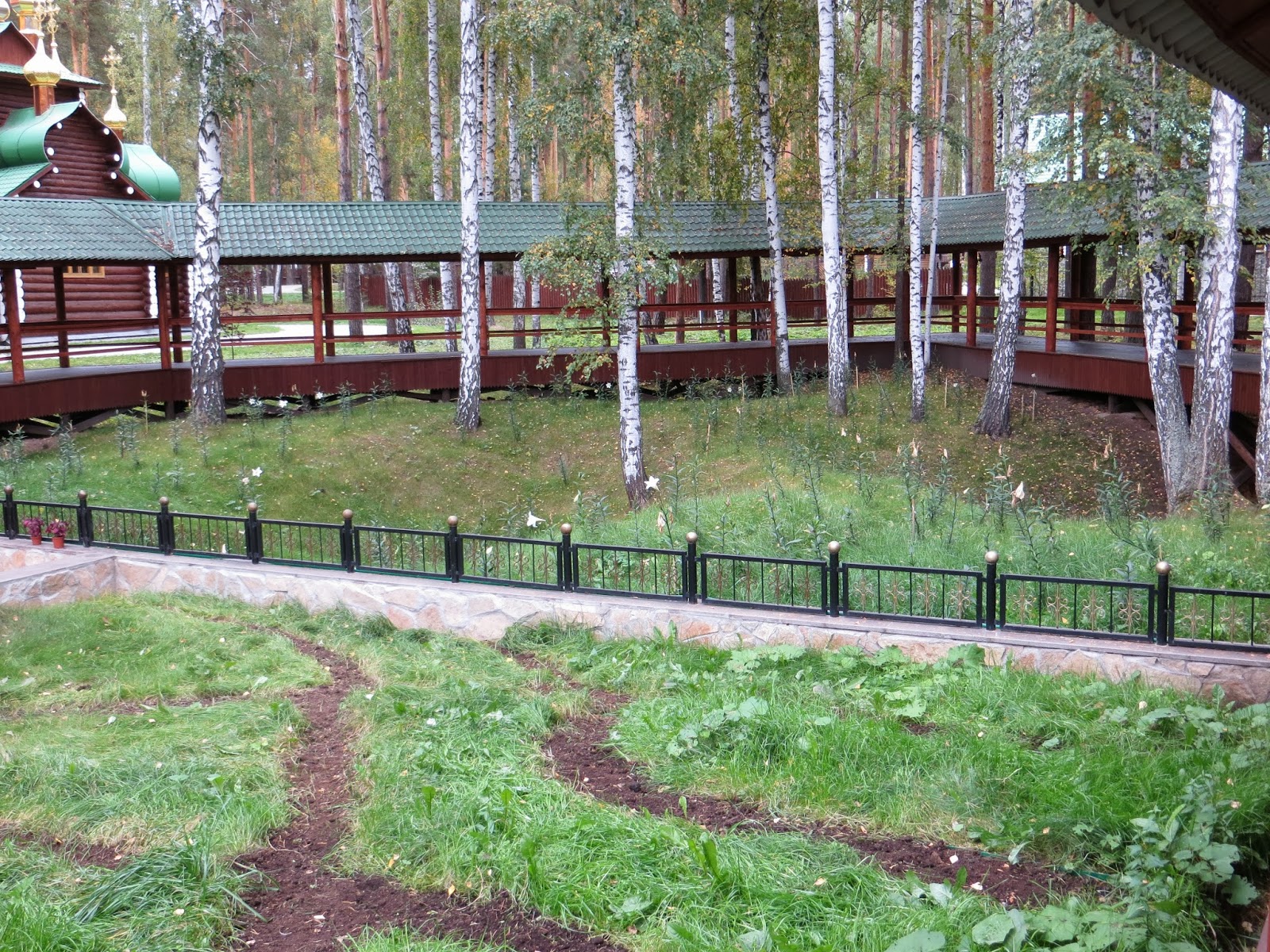
first stop was Ganina Yama which is where the Bolsheviks brought the Tsar and
family’s bodies after shooting them, then doused them with sulfuric acid or lye and
dumped most of the bodies in an old coal mine and then covered them up. Since
the discovery of the remains, the church has built a modern monastery there
with 7 chapels, one for each family member (ignoring the 4 family servants who
also were murdered). We visited the coal mine site and a couple of the chapels.
It seemed artificial to me.


Next
we drove back into town (more modern than anything we have seen because of the
industry (machine tools), fourth largest in Russia, a real city according to
Dasha because it has an Ikea (and also a “motor mile”)) to go to the site of
the Ipaniev house where the family was shot, now the huge Church of the Spilled
Blood. There is a side chapel in the church which is supposed to be located
where the basement room was and there are photos of the room after the
shooting, with damaged walls from the shots (a lot of ricocheting bullets
since the daughters had diamonds sown into their clothes- the diamonds largely
disappeared-what a surprise!?).

We
had lamb kebobs in an very upscale restaurant- crowded with professional
looking young people. When our Nat Geo rep wanted to order some coffee, he
called the waitress “young girl”. I can’t imagine doing that in the US.
Next
stop was the hypothetical border line between Europe and Asia, and again it was
artificial but a lot of fun. There was a very red nosed young guy in a
soldier’s uniform to check our passports and to ham it for the photos, and some
of our group got pictures taken jumping from Europe to Asia and vice
versa.

At
this point the sun started to come out and I really learned that black absorbs
heat- it was the best I felt all day walking on the plaza over the dam where
the city got started. As we were walking here and between the old train station
and the new one, we got the most gawks we have gotten on the trip. I guess it
goes back to being an open city for only a relatively short time.
Connie
email from YK: We
are nearing the end of our rail trip, with only two days to go before arriving
in Moscow. We will be in Ekaterinburg in an hour and will have internet
access at the lunch restaurant, so I'm writing this now so as not to be in a
mad rush like last time, ignoring our table companions (who themselves were
checking in, actually). The sights today center around Nicholas II, the
last tsar, who was murdered along with his family and some of his personal
staff in July, 1918. We've had a lecture and seen two movies about the
family and the events at the time so feel a little prepared to hear the local
guide's presentation on the bus. We'll visit the church which was built
on the spot where the murders took place - the actual house was demolished by
the Soviets around 1976 - then will drive outside of town to see the memorial
erected at the place their bodies were dumped. A sad part of Russian
history, much of which is sad. The final stop before lunch is to an
obelisk marking "the geographical border of Europe and Asia." I
wonder if it will remind me of Four Corners (Remember that, Mike and Beth?)
On
to Kazan.
Thursday,
Sept. 19, 2013 - Kazan
Rain
and about 50 degrees on arrival. The rain got a little more intense during the
early morning but stopped after we visited the Kazan Kremlin. It never did
really warm up beyond about 52 and stayed cloudy.
Kazan
is another big Russian city with more than a million people. It was founded in
1005 and was the seat of a khanate until conquered by Ivan the Terrible in
1552. Now it is the capital of the republic of Tatarstan within Russia (there
is a conflict between Tatarstan’s constitution and the Russian constitution in
that Russia does not allow a republic within the federation to have a president
but the Tatarstan constitution requires election of a president- nothing in
Russia is black and white). Kazan and Tatarstan is mixed- a significant %age of
Russians but a majority of Tatars, mostly Moslem but some Christian. They all
manage to live together harmoniously and intermarriage is quite common.

Kazan
by the way is not on the normal Trans Siberian route- we detoured south
yesterday to get here and will head back north tomorrow to Moscow.
Our
first stop was the Kazan Kremlin (fortress) which provided a great view of much
of the city from its hill. We visited the Kul Sharif Mosque (blue and white)
which was approved to be built inside the Kremlin only in the 1990s. In a city
which used to have a lot of mosques, all torn down by Ivan the Terrible, this
was viewed as a really big gesture since the other dominant structure within
the Kremlin walls is the Orthodox Annunciation Cathedral.
We
drove around a bit with the guide pointing out a lot of high rent condos and
government buildings. We then visited the monastery where the Virgin of Kazan
Icon, one of the three holiest to Russian Orthodox believers and recently
returned from the Vatican, now resides.

Our
guide told us something about tatar cuisine and we went to a good restaurant to
try the good things they do with potatoes (stuffed and folded like a tortilla)
and the honey flour desert called tchak tchak.
After
lunch we went to the Techno Idea Park which is a business incubator somewhat
unique for Russia. Then a short boat ride on the Volga River.
Our
last stop of the day was at the local conservatory where we had a quick tour,
saw some amateur traditional folk singers practicing for a competition, and
then listened to a series of wonderful performances in a small concert hall.
There was an organist, a pianist playing Chopin and Rachmaninoff’s Piano
Prelude, a balilaika and dobro playing pair of girls doing folk tunes and then
a soprano singing a couple of arias.
Two
famous sons of Kazan- Shishkin, the painter, and Shaliapin, the bass.
Back
to the train for dinner and the ride to Moscow.
Friday,
Sept. 20- Moscow- drizzling and about 50 degrees
After
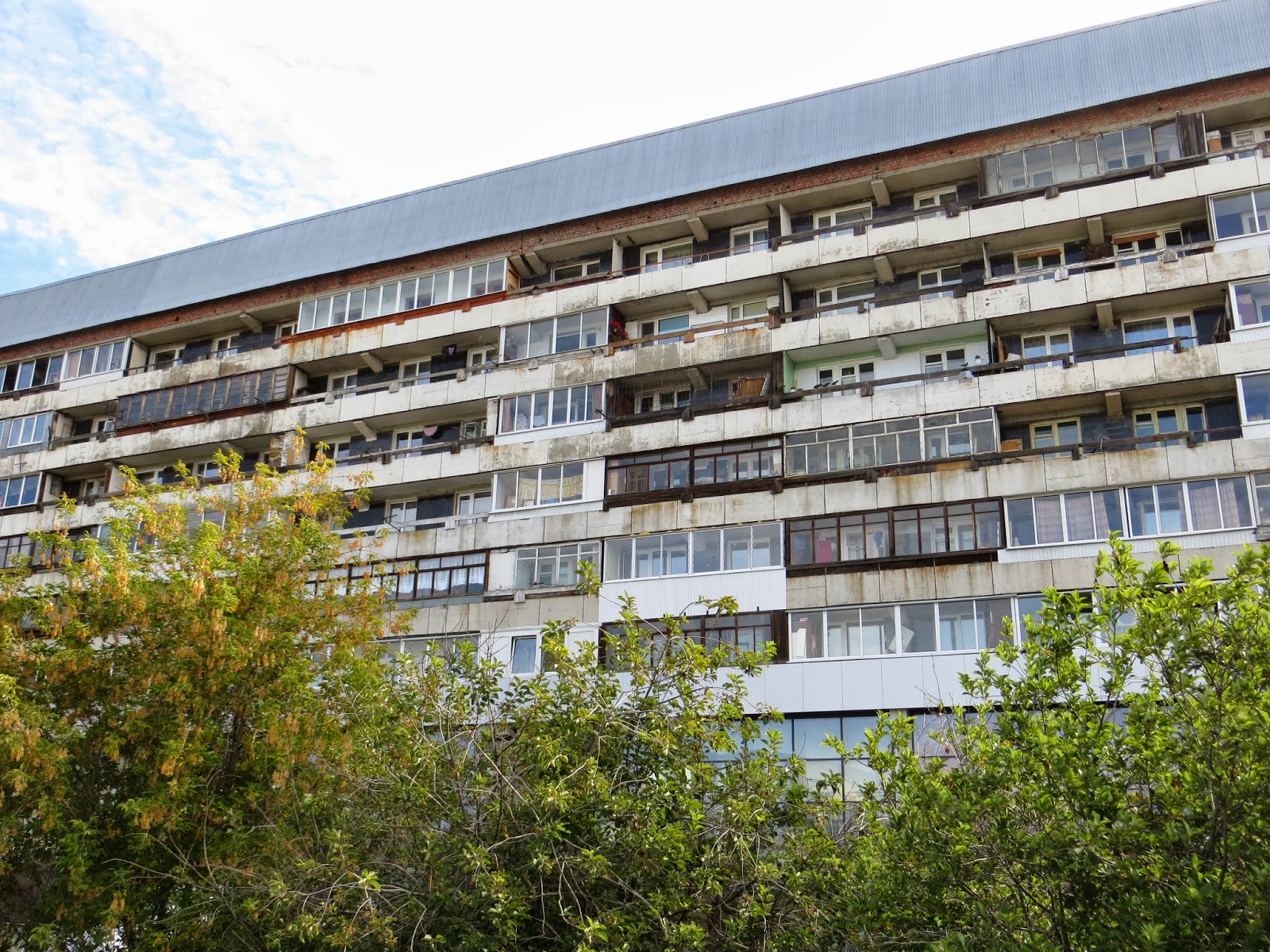
Kazan, we felt like we were back in Europe and in the Soviet Union. Russia does
some things extremely well, like statues, monuments etc, but the rail view into
Moscow was mostly of dilapidated buildings just this side of collapse and the
old rusty looking apartment buildings. I felt like we were back in the 50s.
Then
we arrived at Kazan Station. At once one could feel the vibrancy of the big
city- throngs of people going in every direction.
One
feature of the approach to Moscow especially for us is that the train dropped
the diesel engine about an hour or two outside of Moscow and added a coal fired
steam engine- not much good for the environment but it added to the ambience.


After
saying thank you and goodbye to all the staff we had come to know, and after
making sure all the bags were accounted for, we got on a bus for a quick
overview tour of the city on the way to our lunch at the Suitcase restaurant
owned by the star of Kolya, a famous Russian movie. After lunch I got the
feeling we were killing a little time before we could check in to the hotel rooms,
but we did another couple of spins around Red Square and the Kremlin. Then we
stopped at a place with a good view of the Novodevichiiy Convent, which is known
for two main things- this is the place where Ivan the Terrible sent his wife to
be a nun when he was tired of her (Peter sent his half sister here to get her
out of his hair), and then there is a famous cemetery within the walls where
Khruschev, Mussorgski, Raisa Gorbachov, and Chekhov among others are
buried. At the scenic spot there is also a duck and duckling sculpture given to
the Russians by Barbara Bush. The last stop was an overlook near Moscow State
University with a view of several of the Stalin Gothic towers including the U
and of the Moscow River.


A
word about Moscow- Wow. In the main part of the city, the buildings are a mix
of old, classic, and then brand new. Moscow itself is an example of what the
Russians can do well- The restaurants were lively, the crowd courteous.
We
checked into the Lotte hotel, near Smolensk Metro stop and New Arbat street, to
find a huge TV, a truly wonderful shower, and a heated toilet seat waiting for
us.
Addendum from 2/25/2020, courtesy of Planet Money,
"Japanese toilets are marvels of technological innovation. They have integrated bidets, which squirt water to clean your private parts. They have dryers and heated seats. They use water efficiently, clean themselves, and deodorize the air, so bathrooms actually smell good. They have white noise machines, so you can fill your stall with the sound of rain for relaxation and privacy. Some even have built-in nightlights and music players. It’s all customizable and controlled by electronic buttons on a panel next to your seat.
In Japan, these high-tech toilets are everywhere: hotels, restaurants, bus stations, rest stops, and around 80% of homes. It’s glorious. Then, I come back to the United States, and our toilets are stuck in the age of dirty coal mines and the horse and buggy. They basically have one feature: flush. No heated seats. No nice smells and sounds. No sanitizing blasts of liquid. It’s like cleaning your dishes without water. It’s gross. And it got me thinking: Why can’t we have high-tech toilets too?"
Connie
had a bit of a cold and we felt like we should repack in an organized way so we
took the night off while the rest went to dinner and a walk around Red Square
at night.
Saturday,
Sept 21- rain and 50 degrees
We
had an early entrance ticket to the Armoury Museum and Olga our guide was
excellent. She stopped and explained any number of significant holdings- too
numerous to mention, but, as an example, boots cobbled by Peter the Great for
himself, 10 Faberge eggs, Catherine the Great’s carriages and wedding gown.
Then
in pelting rain we went outside for a quick orientation to the churches in
Cathedral Square (I think I have them straight now) and then on to a great
Georgian restaurant for lunch.

After
lunch Connie and I split from the group again and went to the Tretyakov Gallery
to see our favorites- Shishkin, Vasnetsov, Repin and a couple of others. We
took the Metro all by ourselves and had no major problems. One little mishap-
The Metro machine would not accept Connie’s pass, she asked the attendant, she
didn’t understand him and asked him to slow down, he said "how can I help you if
you don’t understand?". Then we checked and Connie was trying to use her hotel
room key to enter the Metro. Once we found the pass all was ok. A light moment,
but we didn’t have the courage to let the attendant in on the joke.
Dinner
at Armenian restaurant and then repacking.
Home
for me tomorrow and St. Petersburg for Connie.
Note from Connie about her St
Petersburg time- Sounds
like my trip through the airport came off better than yours. I had a
really nice driver who was pleasant to talk with and introduced me to some
Russian "narodni" (homegrown? local color? "real"
people's?) music. I had to ask for help to find the right check-in spot
at the airport but all went okay, and there was an hour to spare before
boarding. I had the center seat, but next to me was a guy about Michael's
age wearing a Clemson sweatshirt. That was cause for saying hello, and
"Nic" turned out to be both pleasant and conversant. He works
on ships, contracts out to different cargo carriers (or something like that)
and was headed home to St. P. for three months' vacation. He had been to
several ports all over the world, including up and down the east coast, and got
the t-shirt while on a South Carolina stop in Charleston. He'd been to
Norfolk but not on a long enough stopover to see Virginia Beach. Anyhow,
it was a good thing we chatted, because when I couldn't find Margarita inside
or outside the terminal, I ran into Nic again and borrowed his phone. Everything
turned out okay; since our plane was 30 minutes early, she had only just
arrived.
So off to the Astoria Hotel, which appears clean and comfortable, to leave my big suitcase, then we went to a new little restaurant called Soviet Apartment, sort of a 50's diner-like interior except how everyone decorated during Soviet Times. Hemingway's portrait on the wall, along with big rugs of animals and photos of classmates that is just how Margarita said that her parents' apartment looked, and the friend who joined us said they still have Hemingway on the wall of her dacha. I took some photos to show you. I had solyanka (that good beef and veggie soup) and beef pelmeni.
We then got on a bus and headed toward the Russian Museum, but this time to the Benois wing, which has its entry on the canal where the Church on Spilled Blood is. M wanted to see a temporary exhibition by a Russian artist named Arkady Plastov. Google him - I really liked his work, more real Russian people stuff. We also breezed through an exhibit by Filipp Malyavin, who M says was sort of the first Russian impressionist, and that was okay, too.
Caspian Odyssey
October 12- October 29, 2016
Postscript- I went
into this trip with a lot of misgivings. I had read about the
Armenian-Azerbaijan conflict with shots being fired recently. I knew Georgia's
relations with Russia had been tense. I had heard about the one man rule in the
other "Stans" post the Soviets, and the recent strongman in
Uzbekistan just died. To say it was an eye opening trip would be to under
describe it. There is a whole other world out there completely different from
what we hear from the news. I am happy to say my apprehensions were 180 degrees
misplaced. More Americans, especially media types and politicians or would be
politicians, should come on a trip like this to learn a bit about people of other
persuasions and how we compare to other places.
October 11- Tomorrow
we leave for Yerevan, Armenia via Paris. This will be a very "out of my
comfort zone" trip- new countries, totally foreign in culture, religion,
language, currency, probably climate. I have absolutely no background for the
history or the culture, the cuisine, or the customs, and what to expect.
Packing has been a problem because of the wide range of expected temperatures-
basically 30 to 80. Keeping clean clothes is another worry on these trips. I
don't know the elevations of the cities we visit so we have to be ready for
rain, and baking, desert heat. So the adventure begins...
Wednesday, Oct. 12-
The flights from Ric to Atl and then to Paris CDG and on to Yerevan had no
hitches, except Connie's bag went to Vienna instead of Yerevan. On the flight
to Paris we sat near two guys with major coughs and in front of two sisters in
law who are on our trip thru another company (Zegrahm Expeditions, 32 out of
the 80 or so total on the train) and who have giant belly laughs about pretty
much anything.
We skipped dinner and
got about 4 hours of sleep but the seats did not convert into very comfortable
beds.
Thursday, Oct. 13-
One interesting thing on the Air France flight into CDG is the dashcam which we
could watch as we got back over land.
The flight to Yerevan
took off on time. It looked like lots were going to be on our train and getting
there a day early. Before we left Paris Natasha Munro found out George was in
line at passport control in Yerevan waiting for the computers to come back on
before he and everyone else in line could clear. At the same time we don't know
where Beth is but assume she is in Armenia or in line with George.
When we landed we had
good news and bad news- Beth is here and Connie's bag is in Vienna. As the lost
baggage guy said, "Welcome to Armenia".


We had a ride to the
Yerevan Marriott (forgot my loyalty card and number) along with another
traveler in our group, someone named Countess Ursula from Poland but now living
in Australia. The Golden Eagle Luxury Tours (GELT) staff met us, including
Tatiana, who was with us in 2013 but not the lecturer from 2013 I have been
calling Tatiana.
Friday, Oct. 14- We
caught up on sleep but had a sleepless spell from about 3-5 am. After breakfast
with Beth, we went with George and Natasha to Echmiatsin, which is the
spiritual center of the Armenian Christian Church.
On the way we stopped
at a big red arched monument to the battle of Musaler in 1915 which took place
12 miles away in Turkey and started the Armenian genocide via starvation ("eat
your dinner and think of the starving Armenians"). The monument is up a lot of
steps and it got to be hard breathing- Yerevan is at about 5000 feet, i.e. like
Denver, so no wonder.


The next stop was a
church at Tsvartnots (same name as the lost baggage office in the airport).
This church was built in 650 and marks the place where St. Gregory the
Illuminator had his vision in 301 that led to the establishment of Christianity
in Armenia, before the Roman Empire adopted it, at a church in Echmiatsin
(coming up). The church at Tsvartnots or an earlier version of it inspired
Constantine and the shape of Hagia Sophia in Istanbul. It was only excavated in
1901. On the site, there are stylized columns and we were serenaded by a couple
of very harmonized Armenian professional opera singers.
 In Echmiatsin there
are three cathedrals- the first is 16 sided barrel church dedicated to St.
Hripsime who was a Christian in the 200s and ran from Rome to escape
persecution but was martyred here. The other notable sight here is several
hrochkars, which are stone tablets similar to runes in Sweden and what they say
or mean is still unknown but often they have Armenian crosses on them.
 The
second cathedral
is St. Shoghakat, built much more recently to honor a third unnamed nun
who was
martyred here but at the same time as Hripsime. Here we also observed
some
women making lavash bread and enjoyed some fresh out of the oven. They
spread the flour out and then spin it like pizza dough and throw it
against the side of an in ground oven. The result comes out in a couple
of minutes and is very
thin, folded over, and in extra large pizza size- you eat it by ripping
off
what you want from the folds.
At last we got to
Echmiatsin, established in 301, with very interesting columns (probably
original, with doves) and then more recent angel reliefs in the entrance. This
is the St. Peter's for the Armenian Christians- the head of the church resides
here and there is a seminary. The main relic here is one of 5 spears held in
various churches around the world that the churches claim the centurion used to
stab Jesus. We did not see it (it has a cross carved in the metal, but the
metal is said to date from the first century).
All of these churches
were well cared for, with beautiful gardens, some different flowers including
one that looked like purple brain coral, and very serene places to just walk
around. While the girls were shopping, I sat next a shriveled old guy with a
chest full of WWII metals from the Russkis but I could not tell whether he was
begging or selling his trophies. I learned later in the trip a specific one of
these medals would sell for $80 in Uzbekistan and for ten times more in Russia.


Armenia is in a tough
spot; still poor (it seems like Russia shipped all the old Lada cars here), no
retirement system for the old, surrounded by Turkey, Azerbaijan, Iran, and
Georgia. There is a tiny pocket of Azerbaijan surrounded by Armenia where the
Armenians threw out all the Azerbaijanis and is a constant source of friction.
I wish we could have gotten a better view of Mount Ararat- 75 degrees but cloudy with a little haze.

Buffet Dinner with the group was huge in amounts of food but we had a lively table.

Buffet Dinner with the group was huge in amounts of food but we had a lively table.
Saturday, October 15.
It was cooler than yesterday but as the day went on the temperatures varied
quite a bit depending on the cloud and wind. We had a very full day ending up
boarding the train, having dinner on board and unpacking in our 77 square feet.
The GELT staff
includes Tatiana, Anna, Margarita, and Nicholas from our previous trip and
Marat, an Uzbek, as the local link.
The goal of the
morning was Geghard Monastery, about 45 minutes out of town. Aram is our local
guide and he seems to know every building in town along with a lot of Armenian
history.
Yerevan
was first
settled in 782 BCE and has been part of probably 7 or 8 different
empires. Though planned by the Soviets for a city of 250000, it now has
1.25 mm out of the 4
mm people in Armenia.
Geghard
is not as old
as the churches yesterday but still old enough to be in the cupola style
(1215). It was quite amazing since it was carved into the tufa with a
larger
non church narthex and many niches in the surrounding hills for the
monks'
cells. The dramatic scenery made it more appealing and quite peaceful.
We had a choir recital deep inside the rocks, and on the way out Beth
found her next apartment.
BTW, Geghard is the place where St Thaddeus brought the spear that pierced Christ and it was kept here before being moved to Echmiatsin. The door of the church has a wooden version of the spear on it.

BTW, Geghard is the place where St Thaddeus brought the spear that pierced Christ and it was kept here before being moved to Echmiatsin. The door of the church has a wooden version of the spear on it.


After Geghard we went
to Garni where we had more lavash straight from the oven and went to a
Hellenistic temple to Mithra, not sure how old. I think 100-200 ad.


Back in town we had a
full Armenian meal again for lunch at Yerevan Tavern. Lots and lots of food.
Next was an area
called Cascade Plaza where there are many, many whimsical sculptures- some
original and some copies of famous ones like the hares at VMFA by Flanagan and
Ala Nui by Botero from Maui.
There also was a huge statue of Tamanyan the Soviet appointed master planner for the city. The plaza is dedicated to him. We walked 400 or so of the 560 steps up the cascade (the last few flights aren't finished yet).
There also was a huge statue of Tamanyan the Soviet appointed master planner for the city. The plaza is dedicated to him. We walked 400 or so of the 560 steps up the cascade (the last few flights aren't finished yet).

C and I had our picture taken by a lion sculpture made out of used tires.

The geopolitics of
Armenia relative to the super powers and its neighbors is extremely complex. We
visited the Genocide Memorial but it is so sensitive even the guide had a hard
time talking about it. He said it was done by the government of Turkey rather
than the people of Turkey to take some pressure off. One and a half mm people
died and on the site in addition to a spire and an eternal flame, there are 1.5
mm evergreens planted in memory. There are also numerous small plaques to
recognize the countries etc that have acknowledged the genocide.


While we were at the
memorial, the weather cleared with enough sunlight for a good photo of both
snow covered peaks of Mt. Ararat, final resting place of the Ark.


Last note before
getting on the train- Armenia ships 700mm dollars of Molybdenum to Germany for
electronics.


Sunday, October 16-
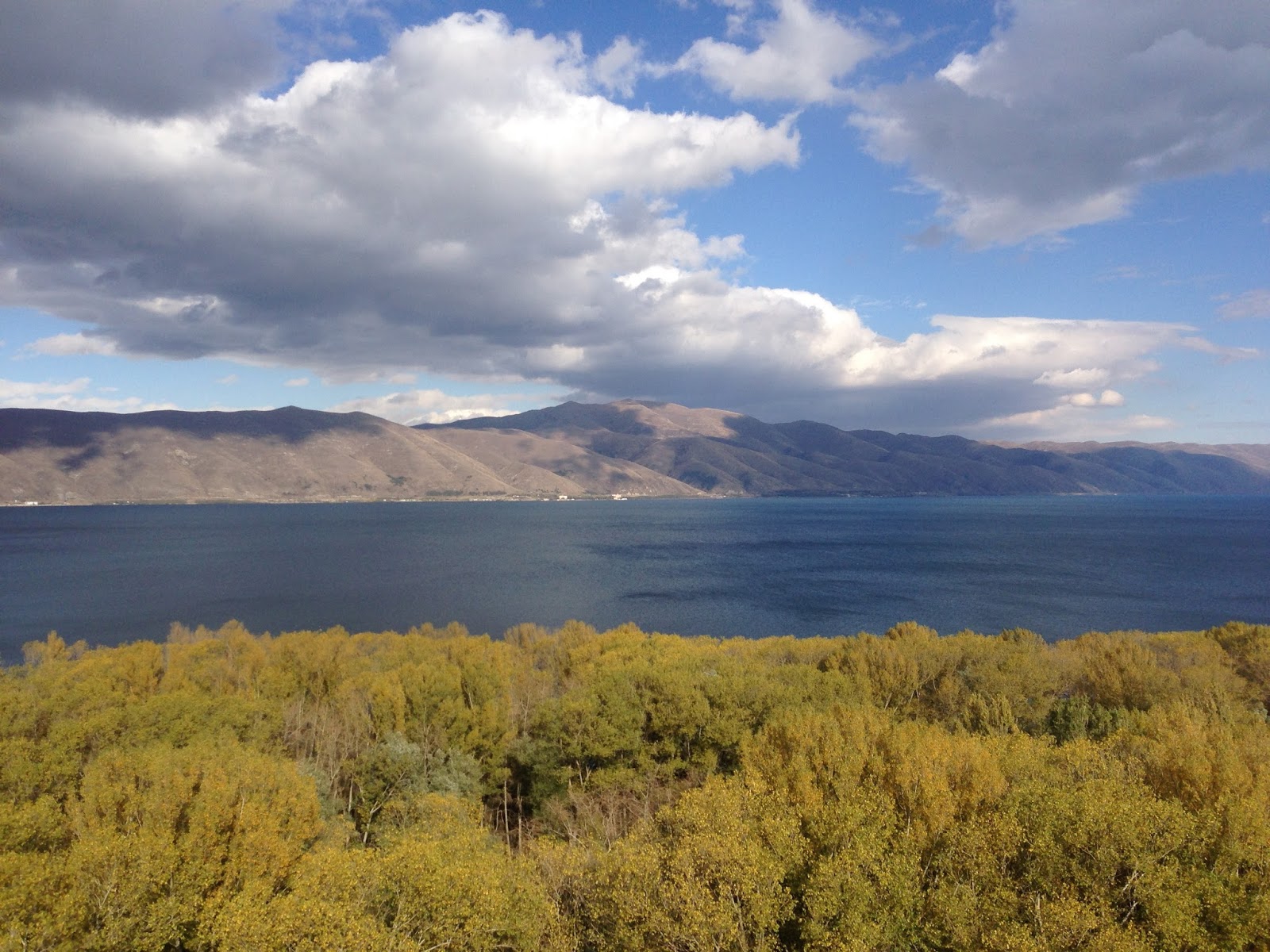
we woke up (well, if we ever went to sleep- the train seems to have more lurches than the TSR did) on the shores of Lake Sevan, a huge (1000
sq. mile) fresh water lake in the middle of Armenia.

This lake is down about 65 feet from where it used to be because of everyone tapping the water for various uses in the Soviet era, but now is coming back with some conservation and a several kilometer tunnel to gather water from streams not usually draining into Sevan.
This lake is down about 65 feet from where it used to be because of everyone tapping the water for various uses in the Soviet era, but now is coming back with some conservation and a several kilometer tunnel to gather water from streams not usually draining into Sevan.
The day's excursion
took us thru Dilijan (meaning "dear heart" after a mother looking for
her son who was fleeing the khan's soldiers because he was in love with the
khan's daughter), home to a World College which costs $35000 per year and has
modern buildings with grass on all the roof tops, and up to
the end of the road to visit another 10th C. monastery restored with help from
a UAE sheik. It was founded on the site where a local threw a chestnut to
determine a good building site. The name is Hagartsin monastery which means
eagle.


 The area looked like
the mountains of Virginia, about the same height, with bold streams running
thru the valleys- brook trout territory. On the way back we stopped for a
panoramic view of the lake. The lake has trout and whitefish, almost fished out
but then restored by a moratorium on fishing.
To
anyone who says
this is a luxury vacation, so far it is hard to sleep on the train, the
shower
is on and off, the sink only has cold water, and the toilet situation is
different. The top bunk is a rock and the pillows are lumpy- more like
camping
out. Maybe we will figure how to heat or cool the cabin tonight (there
is a switch the cabin attendant has to throw to turn out heat or air and
they leave it off when we aren't there- when we ask our guy Roman
(Svetlana is the other attendant for us in Coach 5), he replies "I
button push". But then the
meals are great. BTW one of the guides said they are expecting 4 days of
snow
starting tomorrow.
Very helpful lecture
from George on understanding the history of the
Caucasus relative to Russia this afternoon followed by a delicious dinner of
Olivier salad with crawfish and then a veggie quiche.
Monday, October 17-
transition from Armenia to Georgia, cold rainy day. Our last contact with the
Armenian guide Goro concluded with a plea for us to tell the folks back home
about Armenia and to think about coming back. Just as an aside, currency is the dram and
the Armenians call themselves Hayks and Haykistan after an old ruler.
We had to give over
our passports this morning at the Armenian border and then the Georgian border.
Then we went into Tbilisi on a cold, dreary, rainy day.

The first part of Georgia (from Greek geo, meaning land, and orgos meaning forming or planting) was grassy hills with not much livestock. Then we came into the suburbs which were very dilapidated buildings and old train cars with rust and sections of roof missing. In Tbilisi (currency the lori; both the dram and the lori about 450 to the dollar) the station has several mobile phone stores all together. The section around the station is old soviet run down buildings, with satellite dishes, and the the central downtown is very beautiful in a 19th century way along with a wiry modern Peace Bridge, a spaceship looking, one stop permit hall (pay tax, get a marriage license, start a business all in the same place), and occasional other buildings with modern materials.

We visited an old church with a name too hard to write down (Metekhi), an area where there are baths using hot sulfur springs, and then an excellent restaurant for lunch, all the while freezing a bit.
Lunch in Armenia and
Georgia so far has been consistently filling and the same thing- delicious bread,
lavash and loaves, a salad of cukes and tomatoes, eggplant wraps, yogurt or
cheese or both, a meat course or two (beef dolmas, lamb chops, beef wrapped in
grape leaves, veal stew), then potatoes of one kind or another, and sweets.
Today the sweets were walnuts, prunes and apricots with powdered sugar.
This afternoon we
went to the national museum and had a little lady docent tell us about gold
jewelry from royal digs. Really well done display.


I learned that the Colchis where Jason went after the Golden Fleece is really Georgia and that these old Georgians were the earliest gold fabricators.


I learned that the Colchis where Jason went after the Golden Fleece is really Georgia and that these old Georgians were the earliest gold fabricators.
Skipped dinner to
watch a DVD about Stalin- a little eery, especially being on his home turf.
Georgians of a certain age love him in spite of all the atrocities, maybe
because he is a local boy who made it to the top.
PS early in the
morning George gave us a quick history of Georgia and, like Armenia, "it's
complicated".
Tuesday, October 18-
colder and more rain about 45-50 with the sun struggling to emerge but being
pushed back. Tbilisi turns out to be a very attractive city (1.2 mm out of the
3 mm in the country). We walked from the Liberty Square, with a column and gold
sculpture of St. George and the dragon where Lenin pointing to the "luminous
future" had been, along Abkhazia Street to the gondola, rode it across the river
to the silver Mother of Georgia statue, wine of friendship in one hand and
sword in the other, then thru a park to the Peace Bridge, had a great
khachapori lunch on our own and more walking. This would be a lovely place in better
weather.


Connie pointed out to
me that while the people speak Russian in addition to Georgian there is only
Georgian on the street signs. It looks more foreign than Russian to me.
Much, much
infrastructure needed- hard for me to see how things like the electric
transformers work and how any apartment has an intact roof.
A note about our
fellow travelers- mostly Americans from Seattle and elsewhere, a Canadian, a
few Brits, Brazilians, one from France, at least two couples from South Africa
whom I found out were flat out denied their visas to Turkmenistan and have to
fly back to Istanbul and then to the next stop beyond T. to rejoin us. There
also is a couple from Israel staying in one of the Imperial class suites, which
means they get a private car to drive them to the sites. The total group is 76
in 10 carriages with about 25-30 with the Zegrahm group led by Gary and his
sister Teese. At dinner one night we counted at least 12 native languages spoken
by the group.
Wednesday, October
19- Overnight we went by train to Gori, Stalin's birthplace, and the first
sightseeing stop of the day was his museum at the birthplace. Our cabin
attendant Svetlana came with us today. She said some of her relatives died in
Siberia, and George's wife, Natasha, said this was a very difficult stop for
her because Stalin had had her two grandfathers killed in the camps on the Kola
Peninsula. Talk about a personality cult- There was one room dedicated to
interrogating and sentencing prisoners and the rest was two stories of massive
rooms with memorabilia including the presents the different part of the USSR
gave him for his 70th birthday.


Update: New York Times article from June 2019 on Gori-
https://www.nytimes.com/2019/06/30/world/europe/stalin-museum-georgia-russia.html


Update: New York Times article from June 2019 on Gori-
https://www.nytimes.com/2019/06/30/world/europe/stalin-museum-georgia-russia.html
Next was the
Uplistsikhe cave settlement on some very steep and windy sandstone cliffs
dating back to preChristian times.


After lunch at a
beautiful restaurant with sculpture gardens owned by the man who makes Georgian
brandy (khachapori even better than yesterday's- crescent rolls with melted
cheese cooked on a kebab), we all went to the equivalent of St. Peter's for the
Georgian Church. It is called Svetitskkhorveli Cathedral and is located in
Georgia's first capital city called Mtskheta- these words are impossible to
sort out to my ear.

Last stop was the Jvari monastery, then back to the train for dinner and to clear Georgian customs and enter Azerbaijan. We had to hide anything we bought in Armenia because the two countries don't get along over that bit of territory separated from the rest of Azer.
This is about the halfway point and as Connie said last time we went on the train trip- half my clothes are dirty and half are half dirty and I don't know which is which.
Thursday, October 20-
Baku, Azerbaijan. This was a pretty relaxed day in that we did not get to Baku
until about 10:30, had a walking tour around the old town, a long lunch and
then the rest of the day off to catch up on the third debate.
First
impressions of
Azerbaijan- Azerbaijan is at the end of the Caucasus Mountains where
they
become rolling hills down to the Caspian Sea. The hills are green and
there are
very few people until we get closer to Baku. Then it becomes rural with
goats,
sheep and a few cows wandering all over and feeding including right up
to the rail bed. As we rode thru the rural areas I started seeing birds
in ones and
twos and then in larger groups and finally in real flocks. We had not
been
seeing any birds in Armenia and Georgia except sparrows. These here are
mynahs,
pied crows, and magpies I think. Even closer to the city, it has the
fairly typical
former soviet look- rundown shacks with pools of mud, wrecked or
abandoned
vehicles and rubbish everywhere, then changing to 1960s soviet style
housing.
There also were gas flares and old wells slowly pumping with a lot of
scrap
metal strewn about until the suburbs began. Once in the city it is neat,
clean
and safe according to our guide. The old town (2000 years old) has very
few
people, no trash, actual trash cans on the street, no stray dogs
wandering, no
beggars, and is very attractive.


Azerbaijan has 10 mm
people with 3.5 mm of them living in Baku, which is situated on the end of a
peninsula. The country is shaped like an eagle with Baku at the beak end. Baku
is 28 meters below sea level, as is the Caspian. The country has no established
religion but is 98.5 % Muslim, with 70% being Shia from Iranian influence and
30% being Sunni from Turkish influence. The nation's economy is about 85%
dependent on oil and gas, with the gas going into 2 major pipelines, and
putting out 750m barrels per day of oil.
Azerbaijan's first
oil boom was in the 1860s and lasted until 1914, and it is now in the second
oil boom.
The city was founded
by worshipers of the flame, caused by natural gas close to the surface, and
the symbol now is still the flame. This pagan religion morphed into
Zoroastrianism. The distinctive 3 flame towers in Baku reflect this history.
The tour took us
first to Shirvanshah's Palace from the 12-15th century. Although shelled by Peter
the Great's fleet, attacked in innumerable wars, strafed by the Armenians in
1918, and shaken by earthquakes, significant parts have survived and the oil
has allowed a beautiful and well thought out renovation using some
technological tricks to give a true feel- you can hear servants and see their
shadows below where you walk, and the dome has tiles that look real and then
fall off due to old age and lack of care. The Throne room is particularly
interesting in that you see where the prisoners were held in the dark for
anonymity and stand where the judge stood in trying the case.


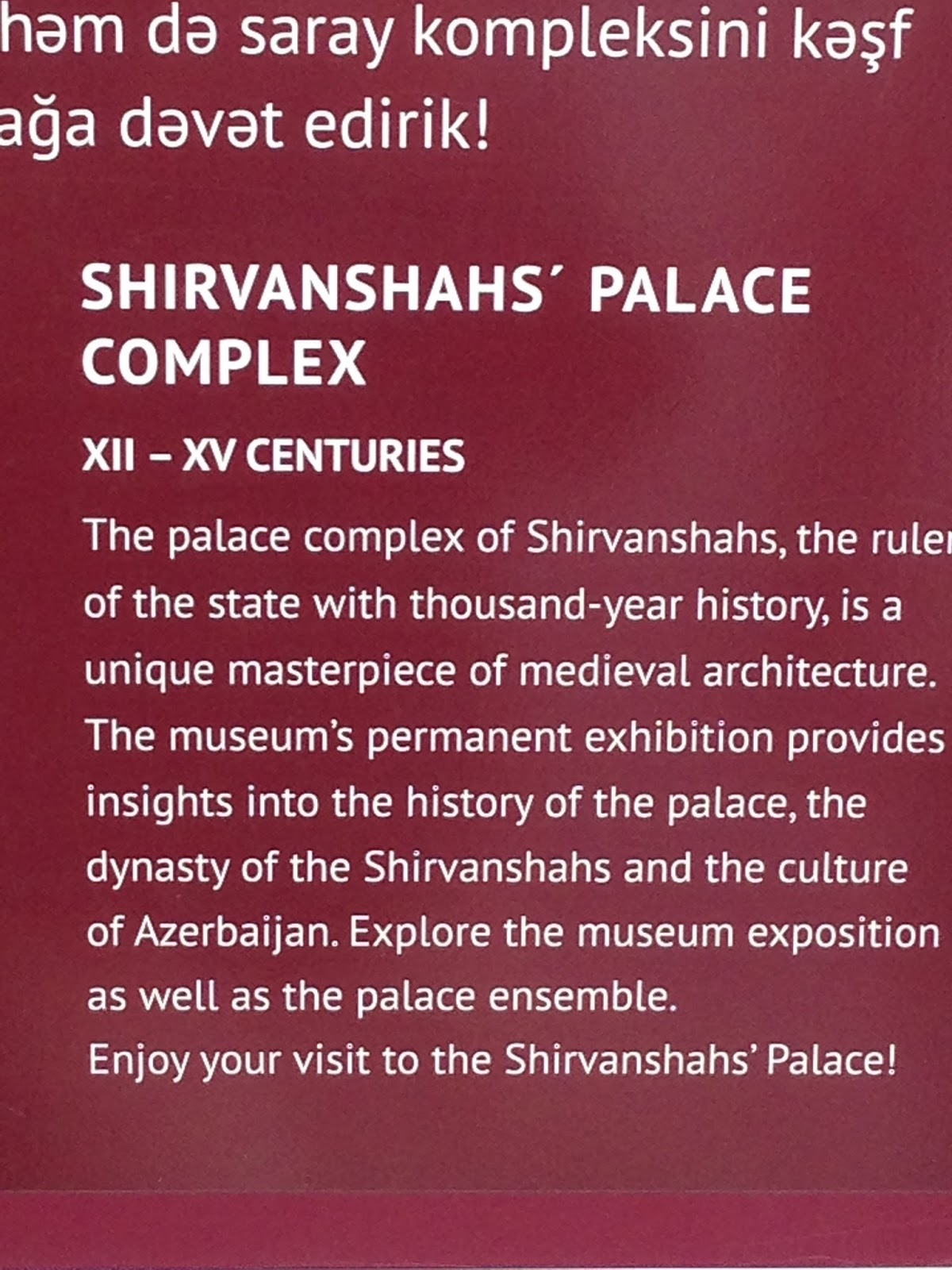
Just outside the wall
there is a statue to a famous Azer poet who was especially adept at
extemporaneous rhyme. The hair in his sculpture shows him doing improvisational
poetry.


We continued to walk
thru the old town to the Maiden's Tower with 8 floors and 145 steps.

Nearby there is the base of a church said to be founded by St. Bartholomew who came to Azer and died here in 72 ad. The church is also near some old baths.

Nearby there is the base of a church said to be founded by St. Bartholomew who came to Azer and died here in 72 ad. The church is also near some old baths.
After
the walk we
arrived at the Four Seasons, our very spacious, comfortable, warm and
wonderful
home for the next two nights while the train crosses the Caspian on a
ferry (some of our group opted to ride the ferry- I didn't know that was
an option until too late, but it would have been an added adventure).
We
had a little rest and then walked to touch the Caspian Sea on the 8 km
waterfront promenade but it was visibly oily (makes sense). A walk back
thru the old town
on our own, buffet dinner at the hotel, and a good night's sleep!!!
 |
| The three Flame Towers in the back |
Friday, October 21-
Still really liking Azerbaijan. One interesting note- geography would say the
Armenia, Georgia, and Azerbaijan are in Asia but they and the VPN thinks they
are in Europe.
Today's first touring
site was Gobustan National Park, but before we get to that, there is more about
the Azerbaijan economy from our guide Yasin:
Oil was known and
used here in the 7th. century bce and was exported on camels by the 4th century
bce. The first well in more recent times was in 1848, i.e. before the
Pennsylvania oil was known. The Nobel brothers of dynamite and Nobel Prize fame
came here in the 1860s looking for wood for gun stocks and invested in a
kerosene refinery in 1876. Their house here was named Villa Petrolea. The first
tanker was called Zoroaster after the prophet. The first boom lasted until the
communists came in 1920 and then interest waned as the Russians focused on
their own oil and gas resource. The land based oil wells are called "nodding
donkeys".
Now 90% of the oil
reserves are offshore and the reserves are expected to last 60 years. Low grade
gas here, 92 octane, costs about 40 cents per liter.
The Caspian Sea
occupies 370000 sq kilometers with an average depth of 200 meters, and a
maximum depth of 1000 meters. It is 3x less salty than the ocean with more
fresh water in the north where the Volga runs into it. Five countries border
the Caspian. There are three kinds of sturgeon in the sea producing caviar but
after nearly being extinct the beluga is protected and farmed now.
The average income in
Baku is $800 per month while outside of Baku it is closer to $400. These
figures may not be accurate since there is a 23% payroll tax so people employed
by big companies receive a w-2 wage and then cash.
The flag has blue for
the Turkic peoples, red for democracy, and green for Islam. Currency is the manat.
Gobustan continues
the Azerbaijan museum streak of great technical displays. This one highlights
the petroglyphs in this area from as long ago as 15000 bce. The museum explains
the different ones and then we went about 3 minutes away to visit them in the
wild. It was a windswept moderately cold day but enjoyable seeing the drawings.
The museum keeps you on the path and away from the grass by drawing a picture of
a poisonous snake with the signs to keep off the grass.


After the park we went back toward Baku to a fish restaurant for lunch. Lots of good food similar in dishes to the other lunch- bread, eggplant, lamb kebab, fish soup, fried whole fish with teeth and head on, but for desert we had jellies that you eat straight up, many different fruits and olive.
After lunch we went
to the carpet museum which was amazing in the explanations of the rugs and in
the beautiful rugs on display. I took way too many photos of the carpets and
other things here.


For dinner we skipped
the group meal and ate in the bar in the Four Seasons. We had a great waiter
named Mahammad who spent a lot of time with us telling us about all aspects of
life in Azerbaijan. I think he might like us to come back.
Saturday, October 22-
Transit from Azerbaijan to Turkmenistan. We are very sad to leave Azerbaijan
where the environment is comfortable and the people are kind.
Our group is noticeably smaller now since the South Africans, Uzbek girl, the 2 Kuwaitis, and a few others for unknown reasons were denied visas, and then there was another handful of real adventurers who opted to ride the ferry across the Caspian (10 hours of a true Caspian Odyssey).

Our group is noticeably smaller now since the South Africans, Uzbek girl, the 2 Kuwaitis, and a few others for unknown reasons were denied visas, and then there was another handful of real adventurers who opted to ride the ferry across the Caspian (10 hours of a true Caspian Odyssey).

We had an easy flight
over to Ashgabat and then a 2 1/2 hour wait to clear passport control.
Turkmenistan takes passports very seriously for a country that wants to attract
tourists.
As
we came out of the
airport (totally empty, just opened one month ago, terminals shaped like
birds- fuzzy photo on the internet, but Connie got one thru the bus
window), in this desert country we saw gleaming white tile buildings and
dozens of
fountains.

Some of the buildings date from soviet times and have been remodeled into white facades but most others are brand new. They do not appear to be occupied- a Potemkin village.

Some of the buildings date from soviet times and have been remodeled into white facades but most others are brand new. They do not appear to be occupied- a Potemkin village.
Turkmenistan
has 6.5
mm people with 750 m in Ashgabat but we could see very few of them.
There was
almost no one walking on the street, few cars on the road, and the
apartment buildings looked empty.
Turkmenistan is another benevolent (?, and with that question mark, if
this were published in the press, Americans would possibly be banned
from getting visas) dictatorship with emphasis on the second
word.
Right now the country is preparing for its 25th anniversary on October 27. Economically the government controls the big corporate efforts thru its bureaus; housing is subsidized; the city is perfectly planned by the government to show off the real or imagined wonderful aspects of life here- gleaming white buildings, manicured gardens, fountains everywhere. Average pay is about $250 per month.
 |
| From our hotel TV CSpan channel |
Right now the country is preparing for its 25th anniversary on October 27. Economically the government controls the big corporate efforts thru its bureaus; housing is subsidized; the city is perfectly planned by the government to show off the real or imagined wonderful aspects of life here- gleaming white buildings, manicured gardens, fountains everywhere. Average pay is about $250 per month.
I really can't
describe it and the photos won't do it justice- imagine a whole city planned by
someone with Donald Trump's ego and unlimited money.
Actually the driver
is natural gas (50% of the economy) and oil (another 15-20 %).
The Russians arrived
in 1881 and in 1948 the city was leveled by an earthquake.
On today's driving
tour we saw the neutrality arch, the president's palace, liberty square with
its statues of notable Turkmen and a column with repeating themes of 27 and 91
for the day and year of freedom from the soviets. But still no people to speak
of. Last stop was the wedding banquet hall and a side view of the desert and
the mountains over toward Iran.


Tonight we went on
another drive around town to see the lights. All the buildings- wedding hall,
Liberty monument, Neutrality monument, all the government agencies (lots of
them), streets, everything is lit with changing colors on the bigger buildings
and monuments. There also is an indoor Ferris wheel all lit up but with no one
in line to ride it on a Saturday night. This city is a mix of Vegas, Disney
World, Atlantis in the Bahamas, what I imagine North Korea to be, and Trump Taj
Mahal.


 | |
| Turkmenbashi as Peter the Great |
Currency is the
Turkmenistan manat.
Sunday, October 23-
Ashgabat, Turkmenistan
Last night we stayed
at the Oguzkent Hotel, formerly a Sofitel, here in Oz. The hotel was staggering
in its apparent grandeur until you pay attention to details- the water from the
faucet flowed red at first, the shower door made no allowance for a bathmat,
the TV worked at night but not in the morning, the toilet paper in the lobby
was about 50% wood chips, the minibar was empty, and the room thermometer was
about 5 degrees centigrade off (on the cold side). We were told Turkmenistan really wants tourists
but you would not know it from the difficulty of clearing our passports. We
were the only guests in probably a 500 room hotel. I think the annual number of tourists is
25000.


Our guide showed us
individual houses being built and said foreigners could only rent, not own. If
they could own, he said they would all belong to Chinese.
On the other hand all
these empty buildings would make a great place to let the Syrian, Iraqi, and
Afghan immigrants live. Turkmenistan could take all of them.
Breakfast today
included the best coffee on this trip!!
As we finished
breakfast, Connie went outside to check the temperature and was shooed back in.
The street in front of the hotel was closed and filled with soldiers, missile launching trucks, troops and troop carriers
and other military vehicles rehearsing for the independence parade (for this neutral country). When I went
out to take a picture I was sent back in, so I went upstairs to take the
picture thru the window.


Today
we visited the
national museum which was another huge building with no visitors and
these huge paintings of the leader in various poses (inside yurts-
making tea, reading a book etc). Then we saw
Old Nisa a fort from the Parthian era 200 bce. Our last stop before the
station
was the grand mosque built at the site where the first president and his
family
is buried. Grand it was.


Biography on the
leaders- The first president was the son of a carpet weaver. His father died in
WWII and his mom and brothers died in the 1948 earthquake so he grew up in an
orphanage. He rose thru the ranks of the communist party to head of the local
party at the time
of independence. The people never saw his own family- they lived in Russia or Europe.
As he got older, his doctors told him to quit smoking. He figured that if he
had to quit the the whole country would have to quit too, so no smoking is
allowed. Tourists are allowed 2 cigarettes per day. When he died in 2006 the
ministers elected the current leader who is a dentist by training. This leader
has served two terms and there is an election in February to pick a new
president. There are at least three parties. However the legislature decided to
change the constitution so the current leader can be elected again.
Update from 2019: In the news regarding the current leader-
Right
now we are
riding thru Kara Kum Desert (the esteemed leader seems to have forgotten
that his country is a desert with all those fountains in public places
evaporating away), dunes and scrub brush, on our way to Darvasa, the
door to
hell, which is a gas hole that has been burning for 45 years. The door
to hell
is, as I understand it, a kind of sink hole that fell in at a minor
construction
site, and the officials noticed that there were foul odors coming out of
it.
They asked for an opinion from geologists who said it was natural gas
but might
harm the nearby residents (the nearest 4 hours away by car). The
geologists recommended lighting
it, expecting it to burn out in a couple of days. Forty five years later it is
still burning.
Update from 2019: In the news regarding the current leader-
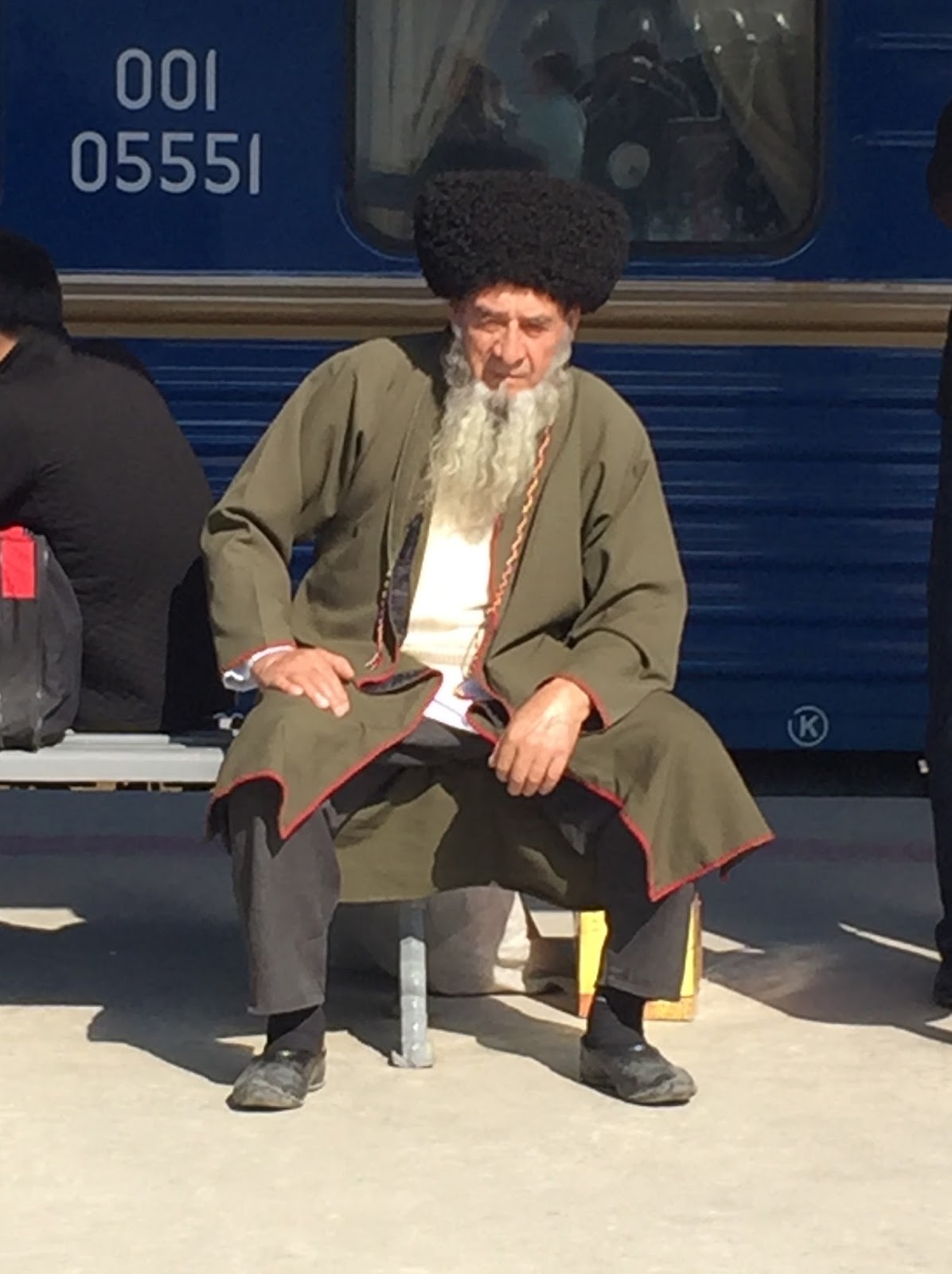 | |
| You can't smoke here but beards are now allowed |
We approached the
Darvasa door to hell at night with very cold temperatures and a bitter wind
blowing (5 layers for me). The train comes within 8 km of it. When we stopped
we all got on Soviet vintage jeeps seating about 8 and set off for 20 minutes across
very loose sand following a myriad of different tracks. The total was 8
vehicles. You could see a faint glow from the start. When we got there, it was
a moonless night but the glow from the hole (about 70 by 70 yards) lit the area,
except on the ground so walking was very deliberate. There were no ropes or
viewing area so we all could walk right up to the edge and peer in at the
flames.

I tried to insert Connie's video of the door to hell but Blogspot won't show it- better look on Connie's Facebook post.
It reminded me of the burning lava you see on TV from active volcanoes in Hawaii along with the bubbling fumaroles at Yellowstone. Every so often the wind would blow a very warm breath of air to ease the wind and cold. The other startling thing about the hell hole is that there were birds flying over it. Some seemed to be sparrow to robin sized and then there was a flock of about 10 bigger birds that would ride the hot air aloft and then fly off only to come back. At first I thought they were some sort of goose because of the way they stuck together; then I thought they were Caspian gulls but the sea is far far away. At the end I think they were doves or pigeons but can't think of why they would be there other than to get warm. Totally amazing all around.


 | |
| Note the people and headlights behind us |
I tried to insert Connie's video of the door to hell but Blogspot won't show it- better look on Connie's Facebook post.
It reminded me of the burning lava you see on TV from active volcanoes in Hawaii along with the bubbling fumaroles at Yellowstone. Every so often the wind would blow a very warm breath of air to ease the wind and cold. The other startling thing about the hell hole is that there were birds flying over it. Some seemed to be sparrow to robin sized and then there was a flock of about 10 bigger birds that would ride the hot air aloft and then fly off only to come back. At first I thought they were some sort of goose because of the way they stuck together; then I thought they were Caspian gulls but the sea is far far away. At the end I think they were doves or pigeons but can't think of why they would be there other than to get warm. Totally amazing all around.

Monday, October 24,
on the way to Uzbekistan. As I write this at 10:30 am we have been stuck at the
border for about 3 hours or so. The Turkmenistan authorities are having as hard
a time letting us leave as they did letting us in. Next we have to go a little
farther and clear entry into Uzbekistan.

Actually now we have
just been told we are hung up here on the border because of a "technical issue"-
no locomotive.
We filled the wait
time with a lecture by George on Tamerlane and then got on our way. After
clearing Uzbek control, we proceeded to Khiva. Uzbekistan looks so different
from Turkmenistan. Very rural, many more plants (less rain but canals from the
Amu Darya River).
It is sunny but 32
with wind. Every layer I had on at once was not enough.
We had a very
informative guide Inez for the surroundings and old Khiva itself. Algebra
inventor statue, Silk Road map, Khiva walls, place, harem mosque, climbing the
wall.


Wall hanging (susani) negotiation, short of cash. Uzbekistan is very secular Moslem country, 30 mm people, size of England. I was more interested in warmth than noting a lot about what we saw. Then back for caviar dinner.


Wall hanging (susani) negotiation, short of cash. Uzbekistan is very secular Moslem country, 30 mm people, size of England. I was more interested in warmth than noting a lot about what we saw. Then back for caviar dinner.
Tuesday, October 25,
Bokhara (the fulcrum of Islam)- the mosques are all beginning to look alike, lots more blue tiles. Less
cold than yesterday although it started off
at 32. It was so
clear I started to worry about a sunburn except I had my stocking cap and a
buff on.
The first stop was
the Emir's summer palace, built to Nicholas II's specs in 1911 but Nick never
visited. We learned a lot about susanis, which are silk or cotton sheets used
as wall coverings or table cloths. We had bought one yesterday in Khiva which I
thought was good looking but expensive and I think the prices moved up when we
got here.


Notes on Uzbekistan-
Marat, our asst tour leader from GELT and Uzbek native, said that the number
one car here is a white Chevy since Chevy bought out Daewoo and Daewoo had a plant
here in Uzbekistan; Uzbekistan has rights to 30% of the oil and gas from the
Caspian but is not spending the revenue profligately like Turkmenistan; there
is one province here where every element of the periodic table can be mined.
The currency is the sum, with about 6000-6500 to the dollar. Purchases for tourists are in dollars; local purchasers use bags of bills- there are no coins.
After the summer
palace, we went into town along the real Silk Road to the Bokhara Registon Square
(the one in Samarkand is more famous).

The name just means a place where things are announced to the people. After a couple of mosques and madrassahs (basically a moslem university for boys 16-25 or so), we visited the mausoleum of a 9th century emir that escaped the leveling and burning of everything here by Genghis Khan because it had become a sand dune three or four centuries later by the time Genghis came thru. Imagine the delight of the archaeologist who found it.
 | |
| Mosque of 40 columns if you count reflection |

The name just means a place where things are announced to the people. After a couple of mosques and madrassahs (basically a moslem university for boys 16-25 or so), we visited the mausoleum of a 9th century emir that escaped the leveling and burning of everything here by Genghis Khan because it had become a sand dune three or four centuries later by the time Genghis came thru. Imagine the delight of the archaeologist who found it.
After a delicious
lunch in an airy but sheltered restaurant that was very similar to the other lunches we have been having, we walked
thru the bazaar and were somewhat aggressively approached by little girl
beggars and boys selling post cards. After getting thru that maze we came to
another mosque with the capacity for 20000 worshipers at once.


Then it was shopping
time.

Somehow C and I ended up the last people in the Unesco carpet factory with Sabina very anxious to sell us a carpet. Miraculously, C and I at separate times picked the same one which we found was a Zoroastrian pattern and tres expensive for us. We enlisted the guide's help, Marat's Uzbek connections, and Visa to acquire a new carpet (Visa turned the charge down but we got that straight). Note the carpet flippers T shirt- try to figure out what it really says.

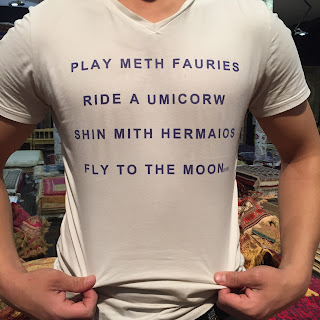

The next problem with the rug and susani is going to be packing, and then US customs.

Somehow C and I ended up the last people in the Unesco carpet factory with Sabina very anxious to sell us a carpet. Miraculously, C and I at separate times picked the same one which we found was a Zoroastrian pattern and tres expensive for us. We enlisted the guide's help, Marat's Uzbek connections, and Visa to acquire a new carpet (Visa turned the charge down but we got that straight). Note the carpet flippers T shirt- try to figure out what it really says.


The next problem with the rug and susani is going to be packing, and then US customs.
On to Samarkand
tonight, but no money to spend, thank goodness.
Wednesday, October
26- Samarkand. About 35 degrees, clear, some wind. The sun is
very low in the
sky all day for this trip so the angle for taking photos is not optimal.
A name out of the Arabian Nights, a little mysterious, a lot exotic:


Our guide today is
Susana and her English is great, knowledge thorough. Beth says she sounds like
the voice at the other end if you called an escort service in London, but I
think she sounds exactly like Martin Short in Father of the Bride.
Details here as
elsewhere will be sketchy on the mausoleums and mosques because I have never
heard of the names and they all pretty much look the same.
Samarkand
is about
2500 years old. It was the base of the Sogdhian religion and culture, a
pagan people who also served as intermediaries for the Chinese silk
trade- we
learned last night via DVD that it was silk flags that turned back the
Romans
when they first took on the Parthians in the Near East just pre ad.
In the Sogdhian days a
newborn was given a spoon of honey so he would be a smooth talker and a gold
coin so he would be a good merchant.
The town was captured
by Alexander the Great and made a capital. His wife Roxane came from Samarkand.
After Alexander died in Babylon, the Seleucids ruled, then the Kushans. In 712
Islam and the Arabs reach Samarkand. This killed off what was left of the
Sogdhian influence but started an Arab renaissance.
Genghis came in the
1200s and destroyed the town (like he did pretty much everything else in Uzbekistan cities) by destroying the aqueduct.
Then in the 14th
century it was Tamurlane or Timur who ruled. He was a local and actually was
buried here. His grandson Ulegbek was more interested in scholarship and
started a madrassah for women and built a gigantic sexton.
Now Samarkand is the
second capital of Uzbekistan (600 m people compared to 200m in Bokhara, out of
30mm Uzbekistanis.
I can't believe all
the colorful outfits on the women here.
Timur's mausoleum,
Registon Square, Bibi Khanym; Ulegbek madrassah on the west of RS, Tiger on east,
and Golden on North, a trip to the bazaar, and lastly the sextant.

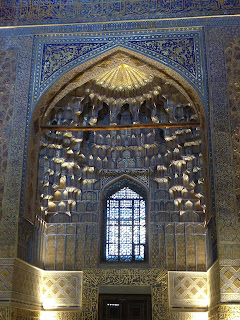


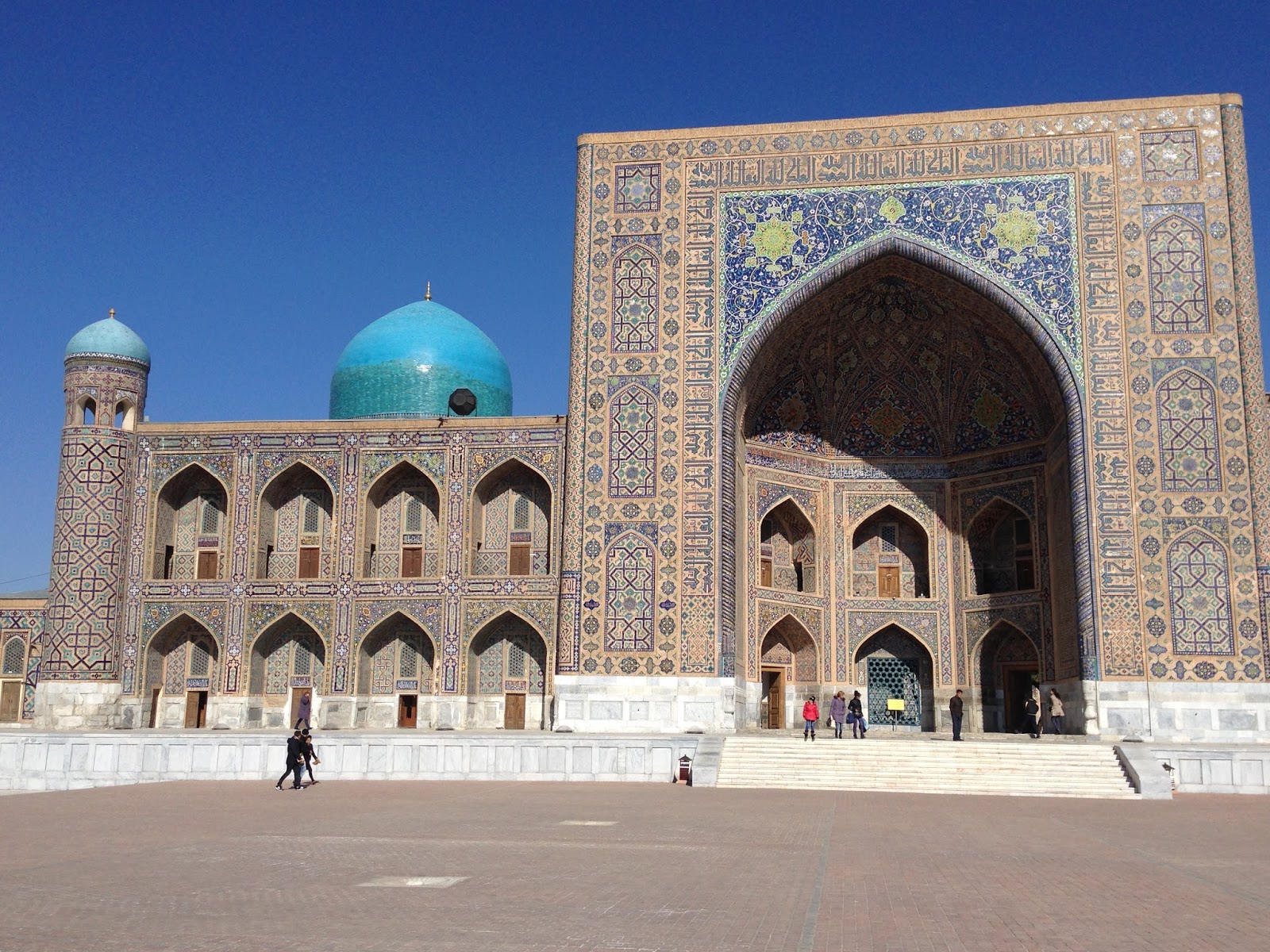


Tonight we all ate dinner off the train at the Astoria Restaurant and had a very colorful and enthusiastic fashion show afterwards.

I suspect any reader
can also tell from the longer descriptions of the last two days that the
temperature has improved.
Thursday October 27-
Tashkent. The weather is in the 50s and clear!!
Today we split up with
C and Betty going with the brother in law Kamol of a J Sarge student Connie
knows and B going on the GE tour.

 | |
| A little bit of an inflation problem |

My guide was Lilia.
Tashkent is big, maybe 2 or 3 million out of 30mm Uzbekistanis, 2200 years old,
and at an elevation of 1500 feet. You can see mountains with snow behind the
city. As usual the Arabs first bring Islam and then the Mongols destroyed
the city but due to a system of canals it hung on. It has been the capital of
Uzbekistan since 1930, and it seems to me the most Russified of the cities in
Uzbekistan that we have visited. This is another secular Moslem country-
freedom of religion is written into the constitution.
There was a big
earthquake here in 1966 and we visited the very impressive monument to it and
how the other republics helped out.


 | |
| Earthquake protection- mud and wood in different directions |
After another couple
of mosques and madrassahs with blue tile named after people I can't remember,
we went to a small madrassah which has the oldest copy of the Uthman Koran, on gazelle
skin from 644 ad. Only about 300 out of the original 1000 pages are there- others
have disappeared over time.
I hope I can remember the minaret joke.

I hope I can remember the minaret joke.

Our last stop was the
museum of applied arts housed in the home of a Russian diplomat from the 19th
century. The pictures tell the story.


Friday, October 28-
Kazakhstan. Long rail ride last night and today, reaching Almaty at 1pm for a
city tour and then a gondola ride up the Sian Khan Mountains after saying goodbye to the train and crew.


As we go across the
steppe there is nothing but fields, maybe summer and winter wheat, with some
snow on the ground and distant snowy mountains. It looks like the big sky
country of Montana except the mountains are further away. 32 degrees at
breakfast.
Kazakhstan (KZ) is
the 9th largest country in the world- who knew? I can name about 5 ahead of it. It has about 17 mm people with
about 1mm in the capital city which is Astana not Almaty where we will be. It
declared independence from Russia in 1991 and was chomping at the bit to go.
About 60% of the people are native Kazakhs with 23% Russians and a smattering
of others like Chinese, Ukrainians, Koreans, Uighurs. It is a very tolerant
place for religions, freedom of choice like the other 'Stans. About 40% are
Muslim. I can't spell the currency- something like tzengdu. The elevation of the city is about 2200 feet.
The language on the
street signs is mostly written in Cyrillic but that is changing to Roman in a
year or so. Most people speak 3 languages- Russian, English and Kazakh.
Almaty refers to
apples which are large and abundant here.

Almaty has wide boulevards, soviet housing, modern office buildings, a gigantic Presidential residence, and the inherited beautiful and meaningful monuments celebrating national history and heroes now. Lenin and Stalin are long gone.

Almaty has wide boulevards, soviet housing, modern office buildings, a gigantic Presidential residence, and the inherited beautiful and meaningful monuments celebrating national history and heroes now. Lenin and Stalin are long gone.
We mostly drove
around the city and then up to the winter sports complex (Shymbulak Ski Resort)
including a 23 minute gondola ride.


Now
resting prior to
dinner (and later finding that someone from Iran tried to get into
Connie's Facebook account when her iPad was open) and then off to the
airport at about 2am.
I just added up the
distance we have traveled- 3800 km or 2400 miles.
One last note on how
enjoyable it has been to have Beth along on this trip. She has kept us laughing
all along the way. The others on the trip including the cabin attendants have
delighted in her eclectic fashions and her acquisitions along the way. The
Asian Indian American woman in the group and at least one of the Brits has said
she reminds them of their daughters and has loved being with her. Two of the
natives along the way have expressed interest (in the form of a number of camels offered), both named Moussa, and one South
African man has offered his son (which I am kind of interested in pursuing).
Other than little sleep
and early and long flights, we got home without problems.
Kamchatka July 11-26, 2018
This is another one of those trips where you can’t quite figure out what time it is relative to home or anywhere else. I think I have figured that the final of the World Cup played at 6 pm Moscow time on Sunday the 15th will be played at 3AM Monday morning here in Petropavlovsk.
Wednesday, July 11 Norfolk to Atlanta to Seoul Korea. Gordon, our super son in law (one of two), got up at 5:30 to give us a ride to the airport. No hitches to Atlanta and then to Seoul, other than it was a really long flight without much sleep (14 hours more or less). Same story as the trip to India- I watched Murder on the Orient Express (1974 version with Albert Finney and an ensemble cast of greats including Ingrid Bergman and John Gielgud); Annie Hall; and the one with the blue people who live on Pandora on it (now that I’m not jet lagged/ sleep deprived I remember it is Avatar). And still had about 7 hours to go.


So I don’t know where Thursday went- sort of “poof” due to the dateline. What I do know is that we were supposed to go to the Grand Hyatt at the Seoul airport and I asked where to find the bus to take us there and we ended up on a bus for an hour and a half to go to the Grand Hyatt in downtown Seoul. We got off and immediately rode an hour and a half back to the correct Hyatt at the airport but our short stay at the hotel amounted to a shower and an hour of sleep before going 5 minutes back to the airport for a 2 am flight to Vladivostok and then a three hour flight to PetroP.
I think we got here Friday the 13th. The next little glitch was the long narrow baggage claim area (a Quonset hut) crowded with arrivals from a Vlad flight and a Moscow flight at the same time, many of whom were trying to get luggage carts thru the crowd.


The photo of the legs and heels is of the girl who butted in front of us in line in Vlad getting her boarding pass for PetroP and then when we saw her again in PetroP. She obviously was dressed to kill, and my bet is that she was coming here for the weekend to see her boyfriend in the military, if she doesn’t fall off the heels and break her leg.
As I was waiting in the thick of the crowd for our bags to come off, a Russki police man came up to me and asked for my passport. We walked back to my backpack and Connie and I showed it to him. Then a buddy of his came up and they both started quizzing me in Russian. The only word Connie understood was “blanket”. After a couple of minutes another uniformed official came up and explained in English that the airplane crew reported that they did not find both blankets that they had given us on the plane. We were basically being accused of taking the Aeroflot blanket. It was a nice blanket but not worth taking. The official was understanding and said he was pretty sure we did not fly from the US to PetroP to steal a blanket. However the consequence was that everyone in the arrival area had to put their bags thru a screening on the way out!! I am not sure how a screening could identify a cloth blanket.
I learned from Bobby, who came in the next day on the same flight, that the crew made an announcement to the passengers that the blankets were the property of the airline and that they were not to be taken off the plane. Thin margins for air carriers.

We were picked up after all that by Yelena and Vasily and taken to the hotel Avacha (named after the bay here and one of the volcanoes). The weather was sunny and mid 60s. We went to dinner (see the photo of me being served a burger (with mystery meat) that one is supposed to eat with gloves), and finally got some sleep.


Saturday, July 14- On to the boat, unpacking, finding our way around, picking up our arctic jackets, tagging my boots, and dinner with Bobby and Marilyn. Then another solid sleep which hopefully will get us set in this time zone.
The SilverSea Explorer holds about 150 passengers. We are said to be “sold out” but I think that means there wasn’t time to get Russian visas for anymore passengers so they called it sold out. Anyway there are about 100 passengers on board including about 40 who held over from the previous cruise up Sakhalin and the Kurils.
Having now experienced this ship, I feel like the Lindblad fleet is closer to camping out. This ship and our cabin (415) are very, very nice. We have plenty of room for our clothes and gear and a 4 foot by 6 foot porthole which makes looking out the window easy. This ship also has the gyroscopic stabilizer system so the boat motion is moderated significantly.

Why Kamchatka someone might ask? We heard that there were such trips from Kathleen and Stuart whom we met on the ‘Stans trip. Connie and I were both intrigued, probably for the same reason Bobby immediately signed up to join us when he heard we were going- we had all played Risk as kids, the board game in which Kamchatka is the key to conquering the Americas and the key access to Asia from the Americas. I learned last night that, while there are 30 cruises per week visiting Antarctica, there are 3 cruises per season coming to the Russian Far East!! This is probably one of the last really remote places on the globe.

Sunday, July 15- PetroPavlovsk
Today’s activity was a tour of PetroP, starting at the small but pretty good local museum. All the display explanations were in Russian and the guide didn’t have great English skills, but there were some Mammoth bones, a lot about the ancient peoples who lived here, the early Russian explorers (Bering et al) and then a good display about the more recent indigenous people called the Koryaks.


We then went to some monuments including one to the Crimean War from 1854 between France and England vs Russia. The allies tried to divert Russia’s attention by mounting a raid on PetroP which the Russians, although out manned and out gunned managed to win (the British commander was so embarrassed he committed suicide). You might say though that this was a strategic victory for the US since the expense of defending Kamchatka is one of the reasons as well as the British threat from Canada to Russian Alaska that the Russians sold Alaska to the US. We visited Alexander Nevsky wooden Orthodox Church- only about 15 years old but built without a nail being used. The other monument we visited was in memory of the Russian war against the Japanese in WWII. I found this interesting because I had always heard that the Russkis only declared war on Japan after Germany surrendered to have a place at the victors’ table and to participate in what went on on the Pacific side. Here we learned that the Japanese had held the Kuril Islands since the Russo- Japanese War and Russia invaded to take them back (long disputed ownership). That is what brought them into the war against the Japanese late in the game. It seems wars never really end.
We made a brief stop by the local market to check out the variety of fish for sale and to taste the salmon eggs.

Next was a visit to Holy Trinity Church, also about 15 years old, followed by lunch at the Kolosseum which was right in front of our Hotel Avacha where we stayed a couple of nights ago (I think I saw that Avacha is the name of the big volcano we saw as we came into town and which has since been covered in mist). (While I am on volcanoes, note that the Kamchatka region or Krai has over 300 volcanoes, 30 of which are active and had a big blow from one in 2008- its first in 3500 years.)
The entertainment at lunch was dances by a group of Koryaks who grew up on the settlement for them and are trying to preserve the local culture. The dances in which Connie and I participated included a lot of imitation of the local animals, one dance which when performed for real can last 18 hours, some that included a lot of suggestive grunting from the males and moaning from the females, some throat singing, and beating on reindeer skin tambourines. Bobby, Marilyn and I got to wear some wolverine and fox skins and stomp around and then Connie took part in the tambourine exercise.
On the way back to the ship we 4 got off the bus and visited the statue to Peter and Paul (not only the apostles but also the names of Bering’s ships) and Lenin’s statue. The plaza with Lenin was also the place to watch a jumbo TV for the FIFA World Cup.


In the evening we met the “expedition team”- history types, a bird woman, a fishery guy, a plant guy, a geologist. We also learned that the passenger list is pretty international- the largest group of 24 is Thai, then the US with 19, then Aussie, New Zealand, Russia, Ukraine, Italy, Canada, UK, Czech Republic, Switzerland, Spain, Germany, China and maybe more.
Monday, July 16- The mouth of the Zhupanova River about 100 nautical miles from PetroP. This is the river I have been talking to the Montana fishing guys about trying for a week for huge rainbows. It is about 100 miles long and so the part we saw here did not look like a trout stream.
The salmon should be here now but they have not arrived. Kamchatka has 6 species of salmon that run the rivers- red, pink, dog, silver, king and char (really sea run brook trout?). This year they are late, the fish processing plant here at the mouth is supposed to be open and isn’t, and the birds and bears are all waiting. Our guide Robin, who is from Boston and took biology from both Stephen Jay Gould (the late evolutionary biologist that Connie and I met at W&L years ago) and E.O. Wilson (wasp expert, Bama fan) told us that there is a “bubble” of hot water in the ocean working its way north that is thought to be the cause of the last two years’ poor salmon harvest. She also mentioned another odd event in the salmon world- this year a net around the farm raised Atlantic salmon in the Pacific broke and released 300,000 Atlantic salmon into the Pacific. They are trying to round them up but that seems pretty hard to do, and who knows what effect that will have on the Pacific salmon. Another factoid I hadn’t focused on- Pacific salmon breed once and die while Atlantic salmon breed 5 or 6 times.
After all that introduction, the activity of the day was a zodiac cruise up the river looking for brown bears (saw 2 from a distance, huge head on the one we saw closer- they are very shy here because they can still be hunted) and Steller Sea Eagles- we must have seen 10 of these huge, beautiful birds that split off from the bald eagle tree about 3 million years ago. The scientific name is Halieetus pelagicus. One more little “fact” about the bears in Kamchatka- we heard that last year some Japanese got too close and had an incident with the bears, but on the other hand we also heard that they have never been known to attack a group of more than 7 people. We had 6 plus the guide in our zodiac so we were safe.

The ride was colder than I expected and I need a little better pocket management to make the things I need to access like sunglasses, gloves, camera a little easier. The cloud has been low so I did not take any landscape photos, but everything is lush and green and there is a lot of rushing water coming down the mountains.

In the afternoon the ship historian lectured on WWII in the Aleutian Islands and connected it back in time to the R-J war of 1904, the opening of Japan in 1850, and the Meiji Restoration (where the shogun lost out after a couple of hundred years in charge).
Tuesday, July 17 At sea most of the day and then Nikolskoye on the Komandor Islands, the westernmost of the Aleutian chain. (Mileage from Zupanova was 200.) This was Vitus Bering day too. There was a good lecture by Peter about how Vitus (1681-1741) who was Danish, joined Peter the Great’s navy, got asked to explore the Northwest Passage for him, had to walk across Russia 6000 miles to get to Ohkotsk, build 2 ships, sail across the Sea of O, land on Kamchatka, then build 2 more ships there to start his exploration. His first voyage went north up the Kamchatka peninsula and then almost to the Bering Strait (Cook came after him by about 40 years and named it for Bering), and back to report to Catherine I, Peter’s wife who succeeded him. Then he did it again, this time with 2 ships named the Peter and Paul. On this voyage he sailed parallel to the Aleutians and made it to America. His ships got separated and it was the one he wasn’t on that got there first, sent 2 longboats to shore but they never came back. On the way back to Kamchatka, Bering’s ship ran aground on what is now called Bering Island, the westernmost part of the Aleutians. He is buried on the part of the island where we go tomorrow.


Nikolskoye is a town of about 700. The people all seem to live in long barracks like buildings, some of which are newer and some pretty weathered. The whole island is a nature preserve. The people get their supplies from an airport which also brings in a few Russian tourists. We were met on shore and accompanied by 2 boys who were very pleasant and I think enjoyed talking to Connie. There was a small museum to visit, some of the wrecked Peter’s cannon, a big red statue of Lenin, and cultural center where we saw some singing and dancing (no audience participation this time). Vera and Yevgeni, 2 of the 4 people on the island who still know Aleut, sang for us. Vera looked about 90 to me.


Back to Bering for a minute- Bering had a biologist on board named Steller, who discovered a number of unique species on this voyage and named them after himself. There is the S sea lion, the S jay, the S sea eagle, the S eider duck, and the S sea cow; then for some reason he deviated from the pattern and named the new cormorant the spectacled cormorant. The Nikolskoye museum has one of 4 known skeletons of the sea cow. It was hunted to extinction within 30 years of Bering’s voyage, but must have been quite a sight- basically a 9 meter long Manatee. Steller is also responsible for giving the scientific names to the 5 species of salmon.

On our way back to the SilverSea Explorer, Connie and I found the boat I have been missing since I gave Leesa the pontoon boat:

Wednesday, July 18 Komandor Bay, Bering Island- A perfectly clear day with bright sun, maybe 50 degrees, water temp in the mid 40’s. This part of the island is totally empty except for some reindeer imported a few years ago (third try to get them established, and now they are causing eco-havoc). Beautiful green cliffs, fog settling down the valleys, kelp on shore, clear water- we came ashore here to see Vitus Bering’s grave and to go on a “long, adventurous hike”. When his ship wrecked here, Bering and his men had to spend the winter in some dugout caves and to try to survive on sea cow meat. Steller advised the men to eat grasses and berries but they didn’t like that idea. Several including Bering had scurvy, but Steller took his own medicine and survived. Bering’s body was exhumed in the 90s for an autopsy and then he was reburied here again. The Russkis also did a facial profile based on his skeleton and found that in life he looked nothing like the picture of him which has been in books for the last 350 or so years. That somewhat obese and frilly looking man was Bering’s uncle.
The hike lasted a good 3 hours, up about a 75 degree grade to a cliff then a gradual uphill for a while, then down at about 90 degrees, and a mile flat walk on the shore. Luckily the vegetation, mostly grasses but a lot of beautiful wildflowers too, was so thick it provided braking on the hills. There were some antlers around. The rocks were a mix of sandstone and volcanic. In total it was 5 plus hard miles and about 55 flights of steps. No gym necessary today.


We got back to the ship at 11, and we are now at sea for about 250 miles back to the peninsula (still 50 degrees, clouding up a little, wind about 20, with whitecaps) and Tymlat village tomorrow afternoon.
Thursday, July 19 At sea and then Tymlat village, population 500. Light breeze, glassy sea right now, 60 degrees in the morning, foggy then clear and back to foggy, water temp about 50.
We just listened to a wonderful lecture by Robin on the life cycle of salmon, the range, how they figure out where they are going, their predators, and the tribal traditions and lore associated with the salmon. I guess if we hadn’t gone on the hike yesterday we could have seen some salmon in the river at Komandor Bay.
The Koryaks in Tymlat are the coastal Koryaks and depend a lot on the salmon.
The salmon just arrived, I saw a few jumping, and we were treated to a version of the ceremony of the first fish. Gulls, kittiwakes, and terns were everywhere. The village is famous for its dancing and the villagers demonstrated it for about an hour- pretty similar to what we had already seen. It seemed like everyone in the village turned out for the festivities, and there is certainly no shortage of children.


Friday, July 20 Yuzhnaya Glubokaya, a deep fjord that used to be the site of a herring plant, about 100 miles from Tymlat. Temp about 50, with fog high on the hills but basically no wind. Activities for the day included a 2 km hike to the plant and up a hummock thru beautiful wildflowers of several kinds. I spotted a bear along the bank of a creek about 1000-1500 yards away. This was a much easier hike than the previous one. There were mosquitoes so I got to try out my bug net.

Next we went for a zodiac ride around the fjord and saw a couple of bear dens, a young brown bear (got an extended view of him sitting on a hillside and then wandering along a rapidly descending stream), horned puffins, pigeon guillemots (remember: very distinctive red feet!) and a red merganser flapping along in the water without taking off.


Space pod plant with yellow flowers- seaside rag wort.
This afternoon there are two lectures, one on kittiwakes and one on the Russian Revolution from 1855-1924.
Kittiwakes are in trouble due to the extended range necessary to get food for themselves and their chicks- not enough resting time so the adults are getting stressed.
Saturday, July 21 On the way to Peter Bay, but then on the way to Anastasia Bay, two more fjords on the way north. Our visit to Peter Bay got scrapped due to weather, maybe temporarily, maybe not. Today the waves are a couple of meters, the temp in the low 40s, we have a little rain and 30 mph wind. Not many people at breakfast. Might be a good day for those long-johns they suggested we bring.
As it turned out I wore all the bad weather gear I had- rain pants, ski gloves, fleece gaiter, fleece hat, my ace in the hole wool t shirt. While Connie was in the gym, I went for an extremely wet zodiac tour (about the same conditions as the one August and I did in Alaska last summer). So far for marine animals, we have seen orcas, a couple of different kinds of seals or sea lions, a couple of sea otters, and now today we added walrus. Yesterday in addition to the live bears we saw one that was the victim of poachers- face (for the teeth), claws and probably gall bladder removed. Here we saw 7 live walruses and 2 or 3 dead ones, also the victim of poachers.

As for birds, here I added a king eider, common guillemots, and pelagic cormorants as well as salty backed gulls and black legged kittiwakes.
We are in a holding pattern for the rest of the day as we see what the weather does.
The afternoon activity was a lecture by Robin on Whale tales- are whales fish?, do whales spout water?, could a whale have swallowed Jonah?, do whales get the bends?, and do whales blow up? See the exploding whale.com on YouTube. The second talk was on pinnipeds ie seals and walruses.
Sunday, July 22 Peter Bay, Natalia Bay, and Bogaslav Island
Yesterday we ended up traveling north to another fjord to try to find calm water for the evening. Then we came back 35 miles to Peter Bay for today’s activities. In the morning there was a zodiac ride, much more pleasant than yesterday’s. Bogaslav has amazing craggy cliffs of nesting kittiwakes, pelagic cormorants, guillemots, horned puffins, and gulls. It was still col (50s) with a meter or two swell, and about 20 mph wind.
For the afternoon we opted for the moderate hike (about 2.7 miles) up to a couple of glacial lakes. The wildflowers were so plentiful and varied. Notable here was a golden rhododendron and a mini azalea. The terrain was tundra soft in places, boggy wet in places, and rocky in places. We saw no bears but did see a couple of bear imprints. The lakes fed into a river that looked perfect for brook trout with small falls, plunge pools and riffles. I looked but saw no salmon.

At 5 pm the ship pulled up anchor and we have a full day at sea ahead of us on the way to Yttygran Island.
It has finally started to clear and we can see some mountains all the way to the top, and a bit of blue sky, no more advection fog.
Monday, July 23- In the Bering Sea for 430 miles until 8 am Tuesday!!!

Notes from Hans Peter’s lecture on tundra:
Ocean surrounded by continents- arctic vs Antarctica= continent surrounded by oceans; conditions today= slick calm; 47; 66 30 = arctic circle; colder than 50 in July; north of the tree line; permafrost- here 1-1.5 meters deep, frozen all year long; axial tilt = 23 degrees; photosynthesis mid June thru September; snow depth, sun light, temp, depth of thaw; plants need to work fast- grow, flower, pollinate; tundra = vegetation without trees; less than 400 mm per year, subzero most of the year, veg days less than 50, permafrost; diff between shrub and tree- one stem vs multi stems; tussock sedge; adaptations- hairy leaves, dry leaves protect new leave, tap root to hold on, dark seed pods- absorb more heat, flowers parabolic antenna for heat, phototropism.
After Hans Peter’s lecture, Danny gave a lecture on 1816, The Year without a Summer. It was the a big volcano blew in Indonesia (Tambora) that sent enough sulphuric into the atmosphere that a spike was recorded in ice logs, the sky kept a golden aura, and the crops failed (all as the world got used to Napoleon being truly in exile). Danny ended with a quote to the effect of civilization exists by geological consent, subject to change without notice (Will Durant).
After the lecture, Captain Maggie opened the bridge to visitors. Connie and I got there in time to see the immature slaty back gulls practicing their landings on the bulb of the bow light. They were pretty comical- Connie said they were getting a core workout.
At tea time today the contests began. In passenger trivia, Marilyn, Bobby, Connie, Mike, our new friend from Australia and a 747 pilot, and I tied for the lead with 12/20 correct answers. In the tie breaker, we won because of our team name- the Klepto-parasites. Who knew a frog’s favorite color was blue,that the youngest pope was 11 years old, or that a human hair has a tensile strength of 3 kg? We all then moved upstairs for a game of 30 questions to reveal the secrets lives of the expedition staff. We have a pretty interesting staff- one has met 3 presidents, peed in a cup next to Al Gore; one, a sweet young girl from Hawaii, had a seal haul out on her surfboard once, and worked as a butcher during school, converting several vegetarians by the smell of bacon; one spent a week on tour with Rihanna and did not enjoy watching the car crash that occurred after the concert.

Tuesday, July 24 in the Bering Sea, idling along in pea soup fog and calm waters on the way to Yttygran island (the fog is so thick that the gulls, fulmars, and kittiwakes that have been our constant companions no matter what distance we are from shore aren’t flying). Today is also the first time we have gone for an extensive period of time without a working wifi.
The fog lifted and it is the best day yet weather wise. We went ashore to an old spot where the native people brought in their whale catches, stored the meat, and set the bones out in a ceremonial or religious display. The bones are mostly from Bow headed whales. The coast was very rocky, almost all gray with some quartz injected in, and there was lots of biological debris such as bones, shells, skeletons of birds and a baby seal, urchins and whelks.
After the shore trip it was so pleasant that I got into the jacuzzi for a while, followed by a view of about 2000 walruses (first time in this spot for 30 years), a couple of humpback whales, and lunch on the deck for the first time.
The ship moved to Poliv Senyavina where there are a couple of hikes and hot springs. I went on the long hike the round about way to the hot springs and then back. Connie, having already exercised in the gym, took the short hike to the hot springs. The water was about 105. The long hike was beautiful, up hill thru some tussock and bog and then down into the river valley which looked like Montana. I actually saw a couple of Sandhill Cranes. The river looked perfect for trout, but what would they do in the winter? I did see a few salmon jumping but none in the river. My phone says it was 6.7 miles but maybe a mile of that I had already done on the ship.

That evening we had the Captain’s farewell dinner at which we shared the table with the Klepto-parasites and Javier from the expedition staff. When we pulled up anchor that night we started an overnight to Provideniya where we checked out with Russian authorities. Provideniya was very soviet looking with the same old block like apartments. We did not go ashore but I bet there was a big Lenin somewhere.

The morning was Tuesday all over again because of the dateline. We woke up at about 7 am Wednesday and then at 8 am we magically moved our clocks to 12 noon Tuesday. The ship served us brunch. Then James gave a great lecture on ocean currents and the plastic duckies and the gyres. Later for tea time there was another trivia challenge. This time since Hans Peter the botanist was the moderator we changed our team name to the Saxifrages after one of the tundra flowers. We did not come close this time even though we had 16/20 of more relevant questions. The lecture which followed by Peter about the Chilkoot Pass and the Alaska gold rush was a non event for me- I went to sleep.
After a dinner that came too early at 7:30 Alaska time but 3:30 body time, C and I tried to sleep but couldn’t quite get there. I think I went to sleep about 3 and woke at 7 as we came in sight of the USA.
Wednesday July 25- Nome
We cleared US customs, waited a while, worked on the 2000 piece map of the world puzzle, and then went into town. I rented a car and we went out in search of salmon running (check) and musk oxen (check).


To the airport and on to Norfolk for S week! I have to add though that the flight from Anchorage to Chicago was terrible- We were in the first row and I could never get my legs comfortable (restless leg syndrome) so it was a very long 6 hour flight.

No comments:
Post a Comment